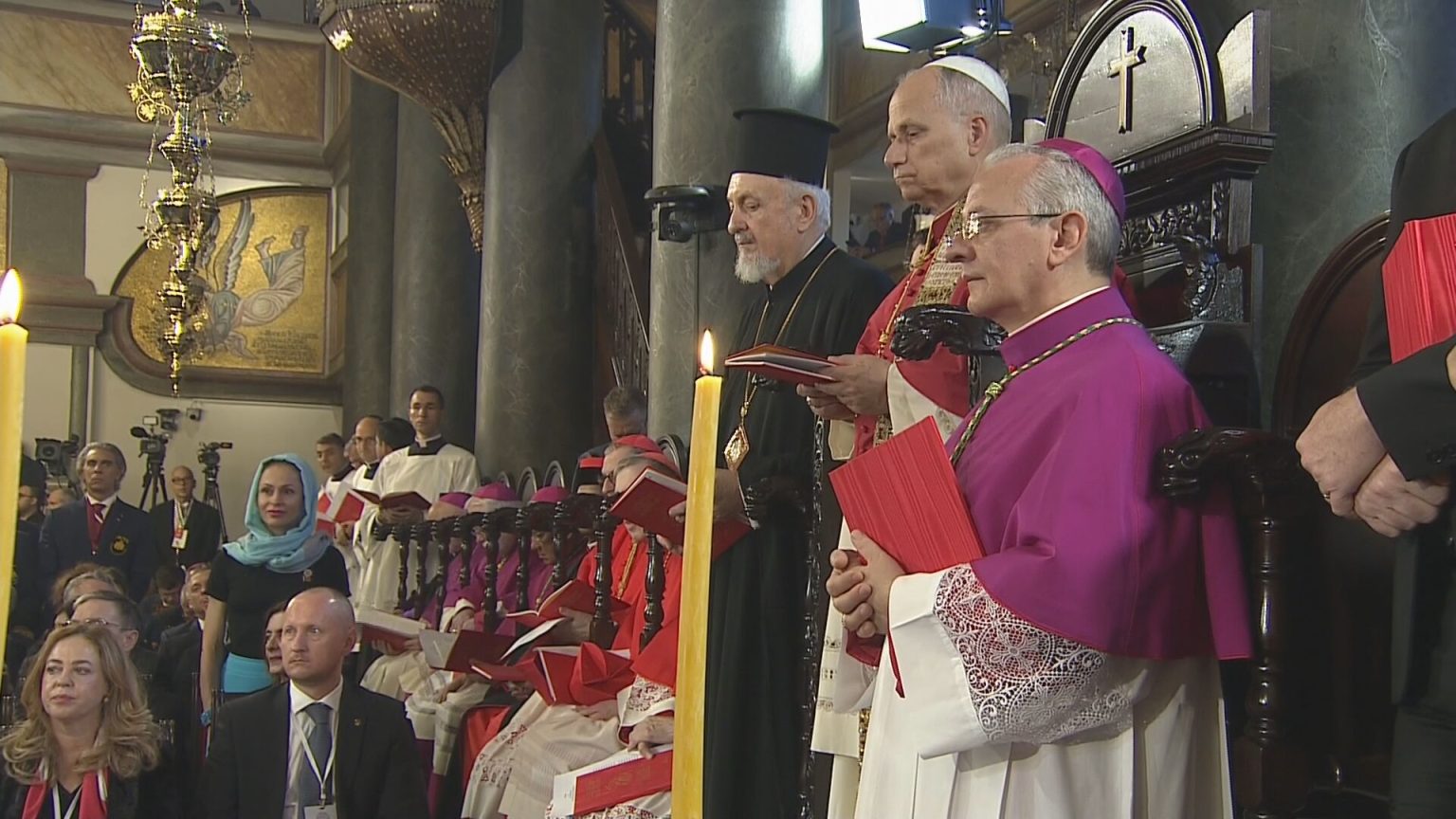
In a display of Christian solidarity with unmistakable geopolitical undertones, Pope Leo XIV joined Ecumenical Patriarch Bartholomew at the Patriarchal Church of Saint George in the Phanar district of Istanbul for the Throne Feast honoring Saint Andrew, the Apostle considered the founder of the Ecumenical Patriarchate.
The Patriarchal and Synodal Divine Liturgy, presided over by Patriarch Bartholomew with Patriarch Theodore II of Alexandria co-celebrating, drew an assembly of hierarchs from both churches, representatives of other Christian confessions, diplomats, government officials, and faithful from around the world. The Greek government was represented by Deputy Foreign Minister Yiannis Loverdos, underscoring Athens' continued close relationship with the historic seat of Orthodox Christianity.
A Symbol of Unity in Divided Times
The Pope arrived at the Phanar at approximately 10:30 local time, greeted by the Ecumenical Patriarch in a scene laden with historical symbolism. Following the Divine Liturgy, the two leaders blessed the assembled faithful from the balcony of the Patriarchal House—a gesture of shared pastoral authority that would have been unthinkable just decades ago.
The visit comes at a pivotal moment in global affairs. As Western nations find themselves increasingly at odds with Russia and China across multiple domains—military, economic, technological, and ideological—the Christian churches aligned with the Western sphere are demonstrating unprecedented cooperation.
The absence of any representation from the Moscow Patriarchate speaks volumes. Since 2019, when the Ecumenical Patriarchate granted autocephaly to the Orthodox Church of Ukraine against Moscow's fierce objections, relations between Constantinople and Moscow have remained severed. Patriarch Kirill's unwavering support for Russia's military actions in Ukraine has further deepened his isolation from both Rome and the broader Orthodox communion.
The Armenian Connection
Earlier on Sunday morning, Pope Leo XIV visited the Patriarchate of the Armenian Apostolic Church in Constantinople, where he delivered remarks that emphasized the shared heritage of ancient Christianity while acknowledging the Armenian people's suffering throughout history.
"This visit gives me the opportunity to thank God for the courageous Christian witness of the Armenian people throughout history, often amid tragic circumstances," the Pope declared, an implicit reference to the Armenian Genocide and ongoing pressures faced by Christian minorities in the region.
The Pontiff also invoked the 1700th anniversary of the First Ecumenical Council of Nicaea, stating: "We must draw from this common apostolic faith in order to regain the unity that existed in the first centuries between the Church of Rome and the ancient Eastern Churches."
Armenian Patriarch Sahag Masalian responded with equally pointed remarks about the necessity of Christian solidarity. "The Armenian people do not forget the Popes who raised their voices in our difficult moments, who stood beside Christian communities in danger, and who defended the truth when the world hesitated," he said.
Addressing present-day challenges, Patriarch Masalian noted that Christians across the Middle East and beyond face displacement, migration, and dwindling populations. "In such times, unity becomes essential. Here in Turkey, our Christian communities live as a small flock, yet one more bound together with mutual respect."
He affirmed the Armenian Church's conviction that "Christian division wounds the Body of Christ, but we trust that the Holy Spirit heals these wounds and brings the Churches closer, step by step."
Strategic Implications
The gathering in Constantinople effectively consolidates what analysts are calling a "Western-aligned Christian axis" encompassing the Vatican, the Ecumenical Patriarchate, the Patriarchate of Alexandria, and the Oriental Orthodox churches including the Armenian Apostolic Church.
This realignment carries significant soft power implications. While Russia has long leveraged the Moscow Patriarchate as an instrument of cultural and political influence—particularly in Eastern Europe, the Balkans, and parts of Africa—the deepening bonds between Rome and Constantinople present a counterweight that transcends purely religious dimensions.
Following a luncheon with Patriarch Bartholomew, Pope Leo XIV departed Istanbul for Beirut, where he will continue his apostolic journey in Lebanon—another nation where Christian communities face existential pressures amid regional instability.
The message from the shores of the Bosphorus was clear: in an era of mounting confrontation between civilizational blocs, the ancient churches of Rome and Constantinople are choosing unity over division, presenting a common front to an uncertain world.
Photo: Ertnews