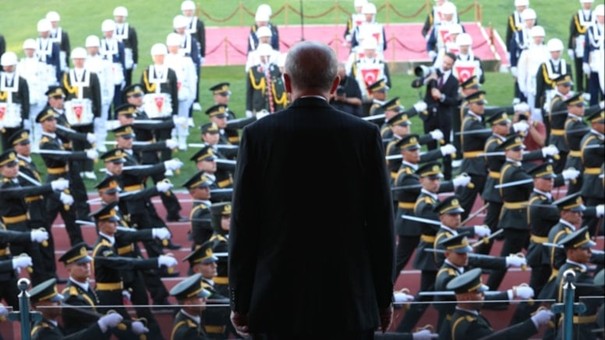
As Turkey enters the tenth year since the failed coup attempt of July 15, 2016, the relationship between civilian authority and the military has undergone one of the most profound transformations in the history of the Republic. According to political analyst Hakan Şahin (Serbestiyet, 13 December 2025), the 2024 “oath crisis” at the Turkish Military Academy graduation ceremony symbolized a new phase in this evolving dynamic — a moment when the military, once again, held a mirror to political power.
From Founding Pillar to Controlled Institution
For decades, the Turkish Armed Forces (TSK) played a defining role in shaping the Republic, not merely as a defense force but as a self-appointed guardian of modernity and secularism. From the 1920s to the early 2000s, this “foundational authority” justified periodic interventions in politics, backed by an epistemic framework that treated the army as both state architect and moral conscience.
The failed coup in 2016, Şahin argues, marked an “epistemic rupture.” Following the purge of thousands of officers, extensive institutional reforms redefined the place of the military within the state. Through this lens, measures such as the subordination of the General Staff to the Ministry of Defense, the closure of independent military schools, and the creation of the National Defense University (MSÜ) signaled not only organizational changes but also the birth of a new knowledge regime — one that replaced military autonomy with political oversight.
The 2024 “Oath Crisis”: An Emergence of Latent Codes
The controversy during the 2024 graduation ceremony, when a group of cadets reportedly resisted elements of the revised military oath, became a metaphor for the deeper friction between inherited institutional culture and the government’s new normative order. To Şahin, this outburst was less a rebellion and more an “emergence” — the resurfacing of suppressed traditions within a redesigned command structure. It exposed the tension between the army’s historical ethos and the centralized civilian control that now defines military governance.
Şahin borrows the concept of “organizational narcissism” from social psychology to explain why the army failed to adapt to societal and political changes. For much of the Republic’s history, the TSK perceived itself as beyond criticism, resistant to outside influence, and epistemically superior to civilian institutions. This mindset, reinforced through rigid hierarchy and insular training systems, insulated it from self-renewal and made it vulnerable to external political intervention after 2016.
The erosion of internal critical mechanisms — where dissent was equated with indiscipline — prevented the institution from responding constructively to Turkey’s massive social transformations: urbanization, the rise of conservative middle classes, and the evolution of political Islam. By the time the AKP government consolidated power, the TSK’s inability to recognize these shifts left it strategically and intellectually unprepared.
Opportunities and Risks Ahead
Şahin identifies the post-2016 reform trajectory as a double-edged process. On one hand, the entrenchment of civilian supremacy and the dismantling of coup-era habits mark tangible progress toward democratic consolidation. On the other hand, the over-centralization of decision-making, loss of professional autonomy, and politicization of officer training could create new forms of “civilian tutelage” and long-term institutional fragility.
If managed wisely, the next decade could see the Turkish military evolve into a more transparent, professional, and technologically advanced force under stable civilian control. Yet if the current climate of defensive insularity and political alignment persists, the TSK risks reproducing its old “organizational narcissism” in a new guise — one justified not by guardianship of the state, but by loyalty to political power.
As Turkey marks ten years since July 15, Şahin concludes, the future of civil–military relations depends on whether reform continues as an instrument of democratization or ossifies into yet another form of centralized control.
Photo: The source