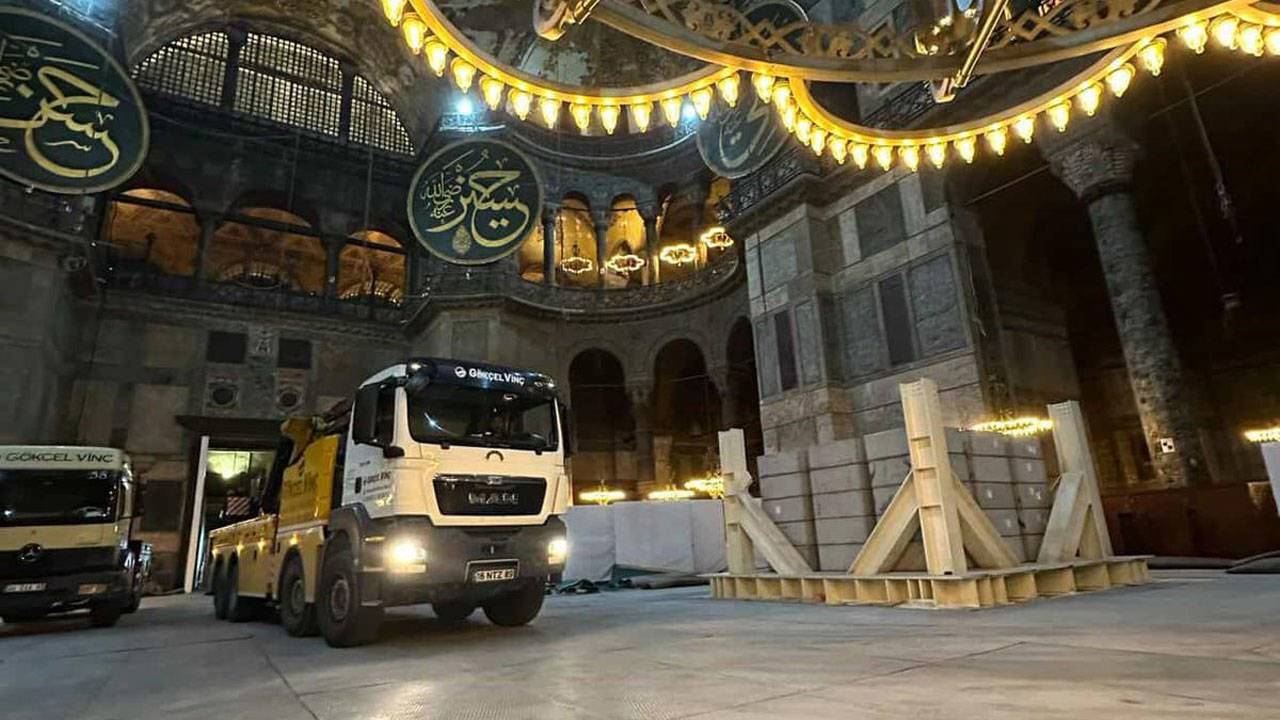
Hagia Sophia Restoration Sparks Outcry Over Heavy Machinery on Historic Floor


The ongoing restoration work at Istanbul’s Hagia Sophia has ignited a fierce debate and widespread public backlash after images surfaced on social media showing heavy-tonnage construction machinery, including trucks and cranes, operating inside the 1,500-year-old structure. The photographs and videos, which circulated widely on platforms like X (formerly Twitter), depicted vehicles maneuvering within the main prayer hall and near the historic Imperial Gate, raising serious concerns among conservationists and the public about the potential for irreparable damage to the ancient marble flooring and structural integrity.

The controversy was first reported by T24, which cited the public outcry over the presence of the trucks inside the mosque, prompting an official response from the Ministry of Culture and Tourism. The ministry defended the operation, stating that "the necessary calculations were made" before the machinery was allowed inside. The ministry’s statement, reported by T24, aimed to reassure the public that the process was not "haphazard or in a manner that would damage the historic floor," but was instead a controlled movement over a specially constructed platform, the result of nearly a year of preparatory work.

Experts were quick to weigh in, with art historians and conservation specialists characterizing the introduction of heavy vehicles onto the historic structure's floor as a "great risk." They argued that the practice violated established restoration ethics and conservation principles, regardless of the precautions taken. The Hagia Sophia, a UNESCO World Heritage site, was originally built as a cathedral in the 6th century and is renowned for its massive dome and intricate marble and mosaic work, making its preservation a matter of global significance.

In a detailed explanation, the Ministry of Culture and Tourism outlined the extensive measures taken to protect the historic pavement. They confirmed the installation of a multi-layered temporary flooring system designed to distribute the load and prevent damage to the underlying marble. This protective system included a vapor-permeable covering, felt, sand, 18mm plywood, a 10x10 cm wooden framework, XPS insulation boards placed between the framework, a sound-dampening mat, and finally, a top layer of diamond-plate steel (baklava sac) to ensure the floor was "completely protected."

The current comprehensive strengthening and restoration work was initiated on the structure's exterior facade and load-bearing system on the fifth anniversary of its reconversion from a museum back into a mosque. This change in status occurred on July 24, 2020, following a decision by President Recep Tayyip Erdoğan. The ongoing restoration is part of a broader effort to ensure the long-term stability and preservation of the iconic landmark.

Photo: T24

More News

Iran’s Leaderless War Machine: The IRGC’s Autonomous Cells and the Escalation Nobody Controls

In the fog of a war that has already claimed Iran’s supreme leader and its top military brass, a new and perhaps more dangerous threat is emerging from the rubble of Tehran’s shattered command structure: a Revolutionary Guard Corps that, by design, no longer needs orders from above. Sources with direct knowledge of the situation confirm that Iran’s Islamic Revolutionary Guard Corps (IRGC) continues to prosecute strikes across the region not under the direction of the new Supreme Leader Mojtaba Khamenei, but according to pre-programmed autonomous protocols embedded deep within its decentralized “mosaic defense” architecture. The result is a war machine that has become, in the most literal sense, self-propelling — and increasingly difficult for anyone to stop. A New Supreme Leader With Limited Command Mojtaba Khamenei was formally elected Supreme Leader on 8 March 2026, succeeding his father Ayatollah Ali Khamenei, who was killed in the opening wave of the US-Israeli “Operation Epic Fury...

2026 US/Israel–Iran War Risk: Why the Chance of Escalation Is Meaningfully Elevated

As 2025 closes, the US/Israel–Iran confrontation is no longer a low-grade shadow struggle managed mainly through diplomacy and proxy conflicts ; it is an openly articulated deterrence contest in which leaders have publicly tied credibility to “red lines” and rapid retaliation. President Trump has stated that if Iran rebuilds its nuclear capabilities or continues rebuilding missile capacity , the response could be immediate and more severe—language that reduces room for quiet de-escalation once a new incident occurs.  At the same time, Iran has replied with warnings of harsh consequences for any renewed attacks, reinforcing a mutual-threat environment where misperception and political signaling can substitute for verifiable facts.  Against that backdrop, the key analytical point for 2026 is not whether a “full war” is the default outcome; it is that the probability that a limited clash escalates into a broader, sustained conflict is meaningfully elevated because the stabili...

Iran's Headscarf Rules Quietly Loosen — But No Law Has Changed

Bareheaded women appear openly in Tehran cafés and streets, yet activists warn the shift is fragile and the law remains on the books. Images have been circulating on social media of something that would have been almost unimaginable in Iran just a few years ago: women sipping coffee in Tehran cafés, strolling busy city streets, and sitting in restaurants — all without a headscarf. The scenes have ignited global attention and renewed debate over whether the Islamic Republic is quietly retreating from one of its most defining ideological pillars. For decades, wearing the hijab in public has been mandatory for all women in Iran — a rule enshrined in the Islamic Penal Code since 1983 and treated as a cornerstone of the clerical state established after the 1979 revolution. Violations could result in fines, arrest, or worse. Yet in recent weeks and months, enforcement appears to have noticeably slackened, at least in major urban centres. A Visible Shift on the Streets Reporters and residents...