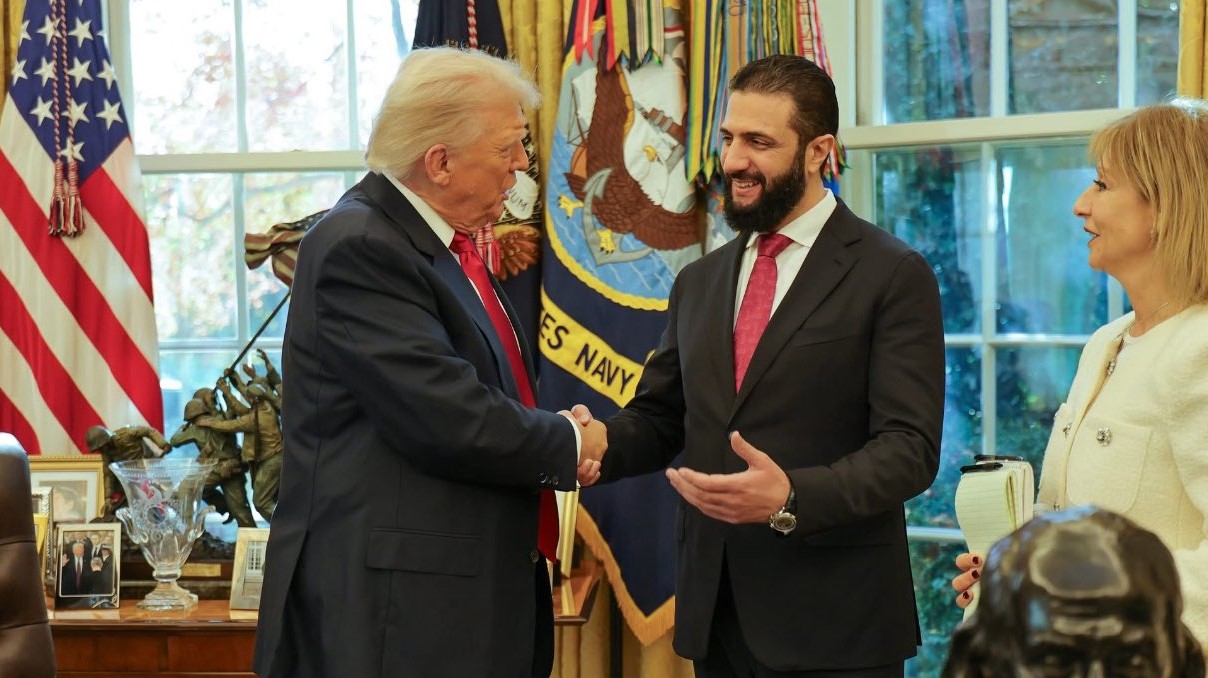
The White House meeting between US President Donald Trump and Syrian Interim President Ahmed al-Sharaa on November 10 has opened new possibilities for both Syria's future and the broader Middle East landscape, with Turkey emerging as a crucial player after Foreign Minister Hakan Fidan was invited to join portions of the high-stakes discussions.
According to veteran Turkish journalist Murat Yetkin, writing for YetkinReport, the Trump-Sharaa meeting could reshape not only Syria but the entire Middle East equation. Yetkin notes that Fidan's inclusion in the meeting represents an unusual diplomatic occurrence that underscores Turkey's maintained influence in Syria's future and suggests Ankara's growing role in the country's reconstruction. While Turkish Foreign Ministry sources initially described Fidan's presence in Washington as "coincidental," Yetkin reports that it appears to have been pre-arranged through ongoing communications between Trump and Turkish President Tayyip Erdogan, though kept confidential until the meeting.
The summit has already yielded several significant outcomes that align with Turkey's strategic interests. The United States has agreed to temporarily lift Caesar Act sanctions against Syria, excluding provisions targeting Russia and Iran. This decision follows the UN Security Council's earlier move to lift its own sanctions on Syria. Additionally, the US has thrown its support behind the March 10 agreement signed between Sharaa and Syrian Democratic Forces (SDF) leader Mazlum Abdi, which envisions the integration of SDF forces into the Syrian army and the transfer of critical facilities including airports and oil fields under SDF control to the government. The agreement had faced uncertainty after the PKK-linked SDF announced non-compliance following an Israeli-backed Druze uprising.
In a remarkable development, Syria has declared its intention to join the international coalition against ISIS. This represents a dramatic shift, considering that until assuming Syria's leadership on December 8, 2024, Sharaa, formerly known by the nom de guerre "Golani," led Hayat Tahrir al-Sham (HTS), an organization that had split from Al-Qaeda and was fighting ISIS, with the US offering a $10 million bounty for him as a designated terrorist leader.
Turkish diplomatic sources reveal that Trump personally invited Fidan to join the Oval Office meeting at a crucial juncture. Fidan conveyed Erdogan's greetings to Trump—a gesture interpreted as a sign of diplomatic trust—and shared Turkey's perspectives on Syria while evaluating areas for Turkish-American cooperation in the country.
During his White House visit, Fidan engaged in extensive discussions with US Secretary of State and National Security Advisor Marco Rubio, Syrian Foreign Minister Asad Hassan al-Shaybani, US Middle East Special Representative Steve Witkoff, and US Ambassador to Turkey and Syria Special Representative Tom Barrack. Vice President J.D. Vance also joined portions of these meetings, where participants reviewed problematic areas in Syria and developments regarding the Caesar Act.
A Turkey-US-Syria trilateral meeting was also convened, marking the second such gathering after an initial session during the informal NATO Foreign Ministers' Meeting in Antalya last May. The discussions focused on field developments in Syria and cooperation opportunities among the three nations. Following the main summit, Fidan met with Witkoff and Barrack to discuss the Palestinian issue, the Russia-Ukraine war, and Iran's nuclear program.
As details of the Trump-Sharaa meeting continue to emerge, the future of the SDF's armed presence in Syria and whether it will place its forces under government command remains a critical question, particularly for Turkey's "Terror-free Turkey" initiative. The strengthening Turkey-US-Syria cooperation is expected to significantly enhance Ankara's role in Syria's reconstruction efforts.
Photo: YetkinReport