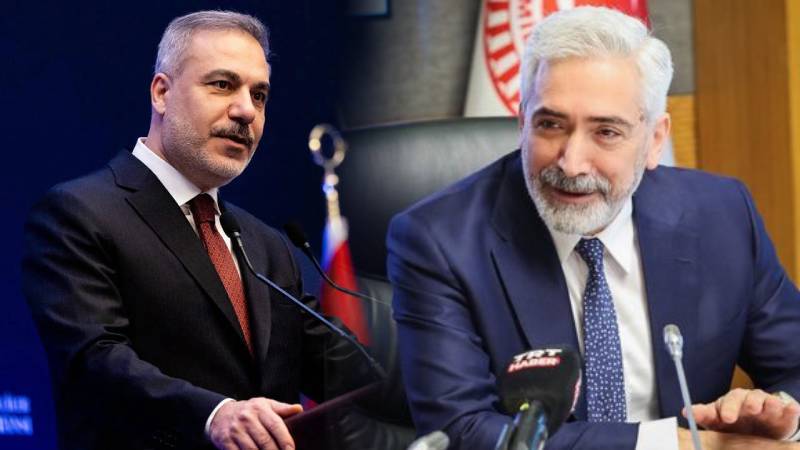
A senior lawmaker from Turkey’s ruling Justice and Development Party (AKP) has delivered an unusually blunt public reminder that foreign policy is set by President Recep Tayyip Erdoğan, after Foreign Minister Hakan Fidan’s recent remarks on Syria’s Kurdish-led Syrian Democratic Forces (SDG). The intervention has intensified speculation in Ankara about turbulence—if not in policy, then in tone and message discipline—between the Foreign Ministry and political figures within the governing bloc.
According to T24, AKP Diyarbakır MP Galip Ensarioğlu criticized the tone of Fidan’s statements on the SDG and said that, under Turkey’s presidential system, no official can act above the president’s line. “The will that determines policy is the President’s will,” Ensarioğlu said, adding: “A person who shows an attitude contrary to the President’s will either leaves the post or is dismissed”.
Ensarioğlu made the remarks during an appearance on Rûdaw TV, in an interview hosted by Hevidar Zana. He framed his comments as a personal critique of phrasing rather than an outright policy rupture, saying it could be argued that Fidan’s wording contained “harshness” about Syria policy or did not reflect “the spirit of the period.” Still, he underlined that “ultimately the final policy is determined by the President, and he has the last word”.
The comments come as Ankara continues to promote the government-backed “Terörsüz Türkiye” (“Terror-free Turkey”) process and related parliamentary work. Ensarioğlu said the National Solidarity, Brotherhood and Democracy Commission is nearing the final stage of its work and is expected to prepare a joint recommendation report based on submissions from political parties. He argued that once parliament reconvenes after the New Year, accelerating the process with concrete steps should be a top priority.
Ensarioğlu also rejected claims of friction between the AKP and its nationalist ally, the Nationalist Movement Party (MHP), over the “right to hope” debate—an issue often linked in public discussion to the future legal status of imprisoned PKK leader Abdullah Öcalan. “There is no contradiction,” he said, while acknowledging that the two are separate parties and will not agree on every detail. He argued the main focus at this stage is removing violence from the equation and drafting a roadmap for disarmament, the fate of armed elements, and “social integration,” rather than tying the entire process to Öcalan’s future.
On possible legal arrangements, Ensarioğlu said technical work is ongoing and that “several different formulas” are being discussed. He stressed that any prospective regulation should not extend to those convicted over the 2016 coup attempt attributed by Ankara to FETÖ, nor to ISIS members or other criminal organizations. He also criticized the timing of a DEM Party rally planned for 4 January, warning that steps that inflame sensitivities could boost counter-nationalism and provide ammunition for actors seeking to sabotage the process.
Fidan’s remarks that prompted the response were made in an interview with TRT World. The foreign minister said implementation of the 10 March agreement between Syria’s government and the SDG had been delayed and urged the SDG to comply “without delay.” He added that “relevant actors’ patience is running out,” while saying Turkey hoped developments would proceed through dialogue, negotiation, and peaceful means.
Photo: T24