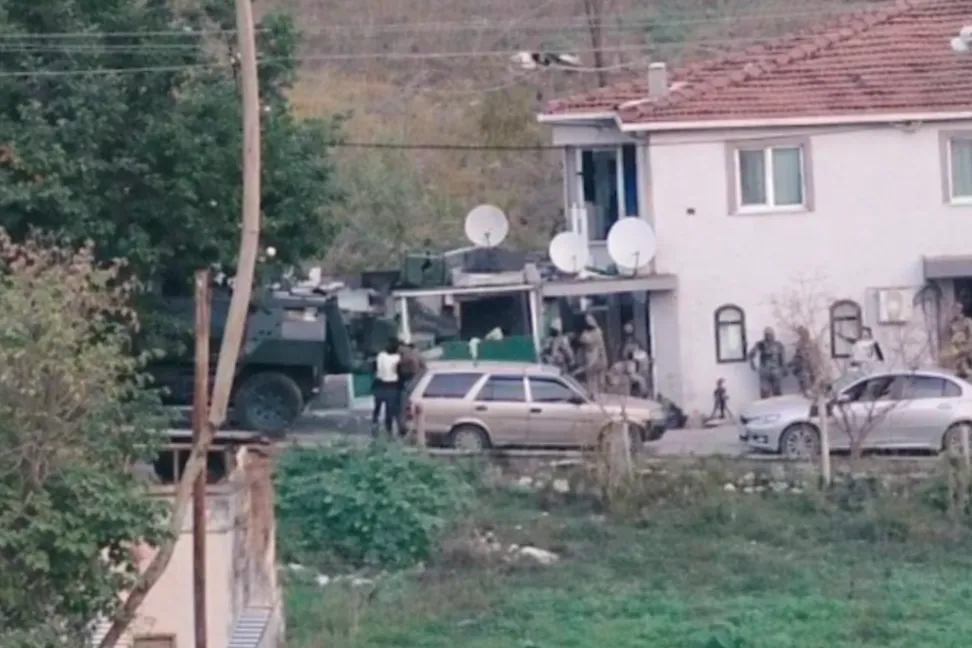
Once again, as we head into the New Year, they have handed the whole country over to the anxiety and fear of an ISIS attack. At the root of both that anxiety and that fear lies a simple fact: for years, the jihadist gangs supported in Syria have been allowed to roam freely in our country, doing as they please. Even a quick look at what happened in Yalova—and a recollection of previous attacks in Turkey—shows how the path was repeatedly cleared for the very same dark network.
The history of jihadist gangs in Syria launching operations under the direction of imperial powers goes back to 2011.
Since then, Syria has been turned into a hub—made into a hub—for jihadist gangs arriving from many parts of the world.
And because the AKP government supported these jihadist forces against Assad from the very beginning of the process, our country—sharing a very long border with Syria—naturally became one of the main transit routes for these groups.
In this way, Turkey became both a base and an organizing ground, turning into one of the central targets for all jihadist forces, including ISIS.
That is the underlying reason behind the hours-long clash we witnessed today in Yalova, and behind the many other ISIS attacks in our country that happened repeatedly in plain sight.
So let’s recall how both Yalova and Turkey were turned into one of ISIS’s main corridors.
Yalova as an Organizing Ground for ISIS
Yalova is a city of around 300,000 people, right next to the country’s largest metropolis.
How did this small, charming town—mostly known for holidays—end up becoming a breeding ground for an ISIS cell?
For anyone following this issue closely, there is actually nothing surprising here.
“In Turkey, ISIS has mainly carried out recruitment and related activities in the Adapazarı Basin (primarily Gebze, Yalova, Karamürsel, Adapazarı Center, İzmit Center), the Konya Basin (Kırıkkale, Kırşehir and surrounding areas), Bingöl, the Adıyaman–Diyarbakır region, Adana and surrounding areas, Istanbul (Sultanbeyli and around the intercity bus terminal), Ankara (around Hacı Bayram), and Bursa.”
Those words are from exactly 11 years ago.
The then-MP Atilla Kart, who voiced this in the Turkish Grand National Assembly, emphasized that Yalova was one of the places where ISIS recruited the most “personnel” in Turkey.
And these words are from 10 years ago:
“Don’t think those joining داعش (Daesh/ISIS) come only from abroad. From very near to us—Yalova, and elsewhere—these young people, whose number we think is around a thousand, are also being deceived and taken away. Then we receive news that they have died.”
This time, the words came from someone in government: then Deputy Prime Minister Bülent Arınç.
Let’s go back to 2014: Azzouz, Al-Qaeda’s leader in Libya, entered Turkey with a fake passport—and was captured again in Yalova in a joint operation by the CIA, MİT, and the police.
Are these intersecting paths in Yalova, over and over again, really just a coincidence?
And don’t say, “But that was years ago…”
Just look at the results of an ISIS operation carried out last year; we see that the ISIS map described at the outset continues to operate exactly as it did:
“Interior Minister Ali Yerlikaya announced that 28 suspects were detained in an operation against ISIS called ‘Heroes-46.’ After it was determined that the suspects were active within ISIS, arrests were made: 3 in Sakarya, 3 in Ankara, 2 in Denizli, 2 in Gaziantep, 4 in Adana, 1 in Düzce, 1 in Yalova, 5 in Bursa, and 7 in Istanbul. The minister also shared that large amounts of foreign currency and Turkish lira were seized during searches.”
In 2021, this time Süleyman Soylu made a statement:
“A major operation was carried out against داعش (DEAŞ/ISIS) in Yalova. ISIS’s hitman in Turkey was caught and arrested! The operation has concluded. We congratulate our Police Counter-Terrorism and Intelligence units, our Yalova Police Department, and the Yalova Chief Public Prosecutor’s Office.”
For years—right next to Istanbul—it has been clear that a consistent ISIS core has managed to establish a base. No matter how much they “congratulate” themselves, it truly isn’t enough.
We are reminding you of these realities today, but we were also writing about them in detail back in 2011. While everyone was applauding the Arab Spring and praising a “Syrian Revolution,” soL was, for a long time, the one voice shouting these truths almost alone. For this country—for the safety of our people—the voice of soL must be louder. Support soL; we all need it.
How Did ISIS Gain Strength Here?
First and foremost: the way was politically cleared for them. We have been seeing this since 2011.
Let’s state that upfront and continue.
Through the religious communities and sect-like networks now freely operating across our country; through the foundations and associations owned by these groups—they have been steadily gaining power.
Let’s go back again, years earlier, to Kart’s statement in Parliament:
“It is seen that the method of joining ISIS operates through foundations, associations, madrasas, and small-scale organizing structures. A third method is carried out through mobile, traveling teams—collecting people from different regions and directing them to certain centers. The names of these foundations, associations, and centers are known to the public. These names have become openly visible. We cannot imagine that the police have not reached these names. What we are facing is a picture that can be described either as direct protection or as incompetence and irresponsibility. The government has to explain this process.”
We are not talking about a hidden truth that has only emerged today—this has been visible for years.
When we place all of this side by side—even just what has happened in a small city right next to Istanbul—we have to say plainly: there is nothing “surprising” here.
We are facing a process for which the government is responsible from top to bottom.
Was Accountability Ever Taken for These Attacks?
ISIS has carried out numerous massacres and terror attacks in Turkey—attacks that are etched into the memory of our citizens.
Details have come to light showing that a large portion of these attacks were clearly foreseeable—and took place with the passive watchfulness of every layer of the system.
Let’s briefly recall just two.
First: Reyhanlı
In the massacre on 11 May 2013, 53 of our citizens lost their lives.
After the attack—carried out one day before Erdoğan’s trip to the United States—the AKP government claimed it was carried out by Syria, and then the “Acilciler” label was added.
After the massacre, Erdoğan said, “53 Sunni citizens of ours were martyred,” and when he went to the U.S., he demanded a no-fly zone over Syria.
But who was really behind the attack?
Days before the massacre, a MİT officer called the Police Department with a tip.
What was in that tip?
How the attack would be carried out, the method, the border-crossing details…
All information was provided except the exact time—and the names behind the attack were shared openly.
Afterward, a briefing note was prepared. Every level of the state knew in detail about the impending attack.
Despite everything being known, the attack happened, and we lost 53 citizens.
At the time, ISIS was “officially” still newly formed, but it was known that this gang—and other jihadist organizations positioned in the region—stood behind the massacre.
They tried to evade the issue by blaming Syria and invoking the “Acilciler.”
Now: 10 October, Ankara
After the attack in which 104 citizens were killed, then Prime Minister Ahmet Davutoğlu said:
“There is even a certain list of people in Turkey who could carry out a suicide attack. You monitor them, but when you act before they carry out the attack, you face another kind of protest… As you know, someone may be in preparation, but unless they turn it into a concrete act—or unless you have data that the act will occur—you cannot detain them.”
Yes—everything was known, just as in Reyhanlı.
It emerged that MİT prepared information and intelligence notes just before 10 October indicating an attack would occur, and that intelligence had reached the police.
Authorities even knew that the bomber, Yunus Emre Alagöz, had “made amends” with his family.
And it wasn’t only these. Suruç, Reina, Sultanahmet, Beyoğlu, the Santa Maria Church attack—these all went on record as ISIS attacks.
What Does All This Tell Us?
It is clear how Yalova—a port, agriculture, and holiday city right next to Istanbul—was turned into one of the centers of ISIS and jihadist groups. And it is equally clear how ISIS massacres in our country, for years, arrived in plain sight.
The government’s obsession with Syria, and the interventions of imperial powers in the region, turned our country into a nest for jihadist gangs.
What we are living through today is precisely the result of that.
And once again, Turkey is entering the New Year with the fear of a major attack.
The operations appearing in the news every day, and the documents circulated on social media “because a tip was received,” only reinforce that climate.
And the attacks, as a consequence of all this—after major negligence—come in full view, repeatedly.
Photo: Sol Haber
* This analysis was first published on 29 December 2025 in Sol Haber and has been translated into English by The Levant Files (TLF) for its readers. The opinions expressed in the article do not necessarily align with TLF’s official editorial line.
Comments
Post a Comment