Watch with Video: Russian Missile Strikes Turkish Cargo Ship at Ukrainian Port (Updated)

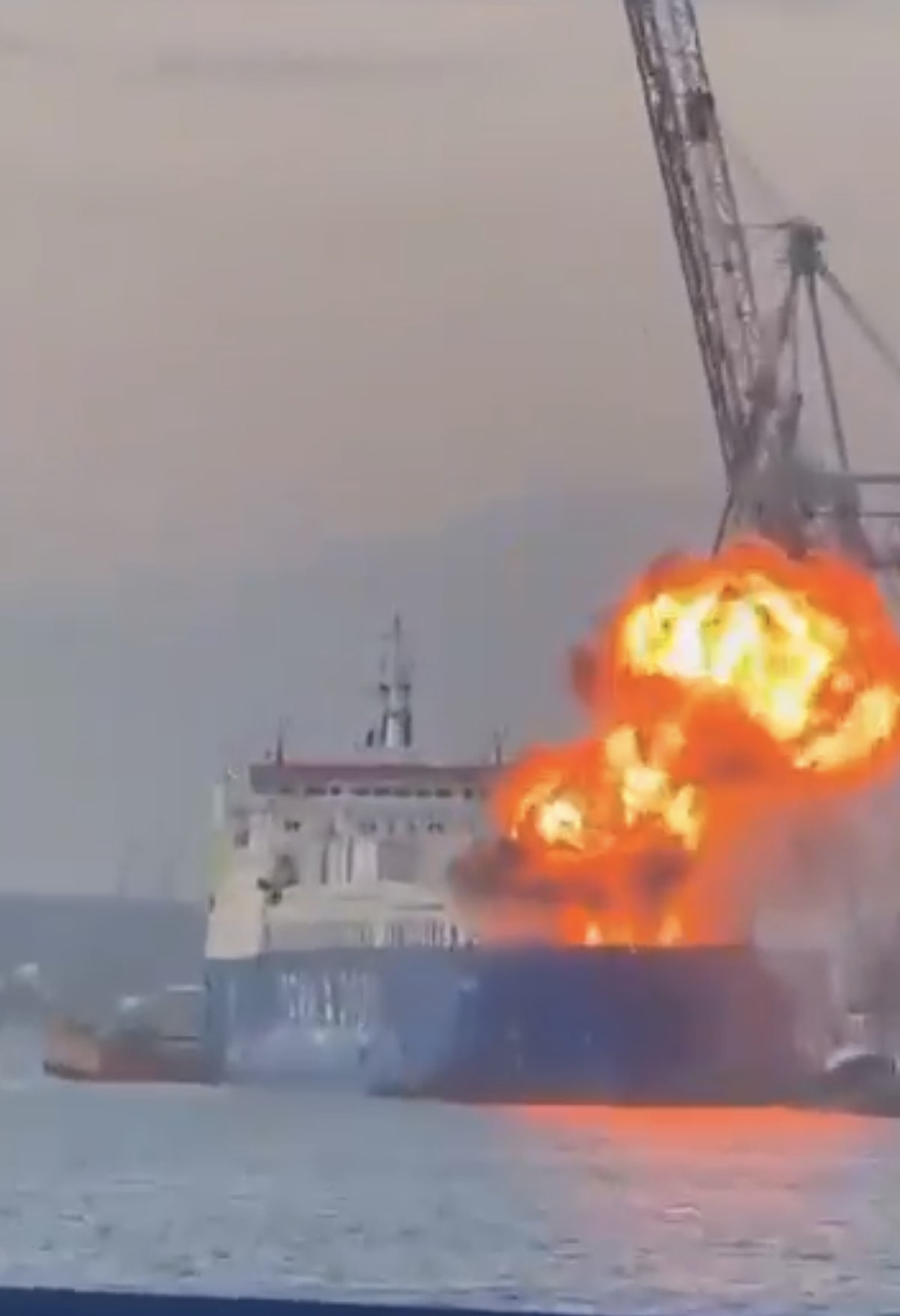
A Turkish-owned cargo ship was struck by a Russian ballistic missile at Ukraine's Chornomorsk port on Friday, sparking international condemnation and raising fresh concerns about the safety of commercial shipping in the Black Sea.

According to the online Turkish news sites, the M/V CENKT, operated by Turkish shipping company Cenk Denizcilik, was hit shortly after docking at the port at approximately 4:00 PM local time. The vessel, which regularly transports trucks along the Karasu-Odesa route, sustained significant damage to its bow section, where a fire broke out following the impact.

Dramatic footage emerged showing the moment of impact, with the cruise missile clearly visible as it approached the vessel. Emergency response teams, including tugboats, port firefighting units, and the ship's own crew, immediately mobilized to combat the blaze, with efforts continuing into the evening hours.

In a statement released Thursday evening, Cenk Denizcilik confirmed that no casualties or injuries had been reported. "The damage is currently assessed as material only," the company said, adding that it was cooperating fully with relevant authorities and evaluating the incident under international maritime law frameworks.

The timing of the attack proved particularly striking, occurring while Turkish President Recep Tayyip Erdoğan was meeting with Russian President Vladimir Putin in Turkmenistan for bilateral discussions.

Ukrainian President Volodymyr Zelensky swiftly condemned the strike, sharing photographs of the damaged vessel on social media. "Today's Russian attack, like many before it, was an action that had no military purpose and could not have one. A civilian ship was damaged at the Chornomorsk port," Zelensky wrote.

The Ukrainian leader characterized the attack as further evidence of Russia's unwillingness to engage seriously with diplomatic opportunities. "This once again proves that the Russians not only refuse to take the current diplomatic opportunity seriously enough but also continue their war aimed at destroying normal life in Ukraine," he added.

Turkey's Ministry of Foreign Affairs issued a formal statement expressing concern over the incident and its broader implications for regional security. The ministry noted that the attack on a foreign-flagged vessel owned by a Turkish company highlighted legitimate concerns about the war's expansion across the Black Sea and its impact on maritime security and freedom of navigation.

According to initial reports, crew members and truck drivers aboard the vessel were being evacuated, with no Turkish citizens reported injured in the attack. The Turkish Consulate General in Odesa is closely monitoring developments and providing necessary support to affected citizens, the ministry confirmed.

Turkey reiterated its call for an immediate end to the Russia-Ukraine conflict, emphasizing the urgent need for arrangements to prevent escalation in the Black Sea. The ministry specifically called for a suspension of attacks targeting energy infrastructure and port facilities on both sides of the conflict.


UPDATE: Turkish Foreign Ministry Issues Official Statement

The Turkish Ministry of Foreign Affairs has released an official statement regarding the attack on Chornomorsk Port.

The ministry stated that the damage sustained by a foreign-flagged vessel owned by a Turkish company during today's attack "points to the legitimacy of our previously recorded concerns regarding the spread of the ongoing war in our region to the Black Sea surface, as well as maritime security and freedom of navigation."

According to preliminary information, crew members and truck drivers aboard the vessel are being evacuated, and no Turkish citizens have been harmed in the attack. The Turkish Consulate General in Odesa is closely monitoring developments and providing necessary support to Turkish nationals.

The ministry emphasized the urgent need to end the war between Russia and Ukraine, calling for arrangements to prevent escalation in the Black Sea. Specifically, Turkey urged both parties to suspend attacks targeting navigational safety, energy infrastructure, and port facilities.

Videos: YouTube (Yazar Gazetesi, T54 Haber, Mersin Haber, TGRT Haber)

More News

Iran’s Leaderless War Machine: The IRGC’s Autonomous Cells and the Escalation Nobody Controls

In the fog of a war that has already claimed Iran’s supreme leader and its top military brass, a new and perhaps more dangerous threat is emerging from the rubble of Tehran’s shattered command structure: a Revolutionary Guard Corps that, by design, no longer needs orders from above. Sources with direct knowledge of the situation confirm that Iran’s Islamic Revolutionary Guard Corps (IRGC) continues to prosecute strikes across the region not under the direction of the new Supreme Leader Mojtaba Khamenei, but according to pre-programmed autonomous protocols embedded deep within its decentralized “mosaic defense” architecture. The result is a war machine that has become, in the most literal sense, self-propelling — and increasingly difficult for anyone to stop. A New Supreme Leader With Limited Command Mojtaba Khamenei was formally elected Supreme Leader on 8 March 2026, succeeding his father Ayatollah Ali Khamenei, who was killed in the opening wave of the US-Israeli “Operation Epic Fury...

2026 US/Israel–Iran War Risk: Why the Chance of Escalation Is Meaningfully Elevated

As 2025 closes, the US/Israel–Iran confrontation is no longer a low-grade shadow struggle managed mainly through diplomacy and proxy conflicts ; it is an openly articulated deterrence contest in which leaders have publicly tied credibility to “red lines” and rapid retaliation. President Trump has stated that if Iran rebuilds its nuclear capabilities or continues rebuilding missile capacity , the response could be immediate and more severe—language that reduces room for quiet de-escalation once a new incident occurs.  At the same time, Iran has replied with warnings of harsh consequences for any renewed attacks, reinforcing a mutual-threat environment where misperception and political signaling can substitute for verifiable facts.  Against that backdrop, the key analytical point for 2026 is not whether a “full war” is the default outcome; it is that the probability that a limited clash escalates into a broader, sustained conflict is meaningfully elevated because the stabili...

Iran's Headscarf Rules Quietly Loosen — But No Law Has Changed

Bareheaded women appear openly in Tehran cafés and streets, yet activists warn the shift is fragile and the law remains on the books. Images have been circulating on social media of something that would have been almost unimaginable in Iran just a few years ago: women sipping coffee in Tehran cafés, strolling busy city streets, and sitting in restaurants — all without a headscarf. The scenes have ignited global attention and renewed debate over whether the Islamic Republic is quietly retreating from one of its most defining ideological pillars. For decades, wearing the hijab in public has been mandatory for all women in Iran — a rule enshrined in the Islamic Penal Code since 1983 and treated as a cornerstone of the clerical state established after the 1979 revolution. Violations could result in fines, arrest, or worse. Yet in recent weeks and months, enforcement appears to have noticeably slackened, at least in major urban centres. A Visible Shift on the Streets Reporters and residents...