By Sehr Rushmeen
Iran is in a contemporary scenario of a considerable degree of political and strategic susceptibility, a condition that arises out of a meeting of increased internal instability and re-estergation by the United States. Since the end of December 2025, economic collapse has sparked protests, which have risen and spread across the country hence becoming a substantive threat to the credibility of the Islamic Republic. At the same time, the news that Washington is looking into military contingency plans due to the internal suppression by Tehran, as well as its regional posture, has only increased the fear that the domestic crisis in Iran can turn into a more significant security issue of regional and global proportions.
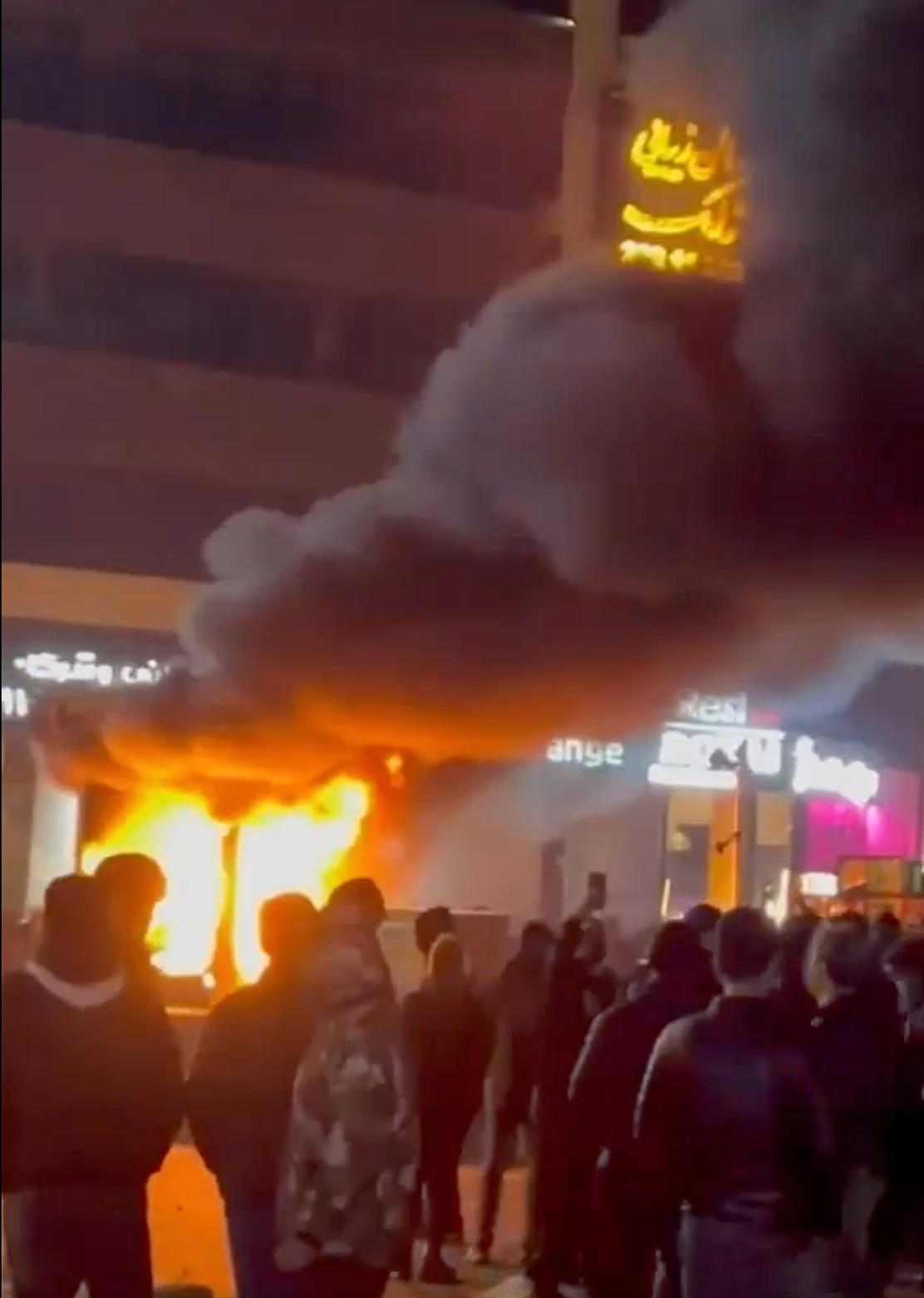
The activity that has been demonstrated sweeping across Iran has first appeared as manifestations of economic suffering. The accelerating inflation rate, a grossly weakened rial, massive unemployment and extreme shortages of necessities do not help the living standards of the various socio economic classes. The key difference between the current turmoil and previous economic demonstrations lies in the fact that it is becoming more and more politicised: the slogans of the rallies are already directed not only towards a specific policy issue but also at the clerical apparatus itself, which is a symptom of more serious crisis of legitimacy and not just a policy conflict. These demonstrations have spread out in all the provinces including big urban centres and peripheral towns, which means that dissatisfaction is no longer limited to a specific geography or social category.
The reaction of the government has been firm and stern. The security forces, such as police units, the Basij militia, and part of the Revolutionary Guard have used lethal weapons to break up protestors. According to the independent estimations, the number of dead people is increasing drastically, but the exact numbers are still hidden by the total internet and telecommunications blockade introduced by the government. In 1000s it is said that thousands of people have been detained and judicial officials have even threatened participants that they might face the harshest of charges under the Iranian legal system with some of them attracting the death penalty. The leadership has tried to justify repression to contain defection in its fray of security groups by using the characterisation of protestants as existential dangers to the state or as proxies of external enemies.
At the same time, the internal crackdown is staged in the context of increasing global apprehension. Recent statements have been made that the high-ranking officials in Washington deliberated on the possible military reaction in the event of further worsening of the actions of Tehran which included the hypothetical strikes against Iranian bases. Although no concrete course of action has been taken, the very fact of such discussions is a clear indicator that a poor bilateral relationship is developing. The rhetorical support of the U.S. political authorities to the demonstrators in Iran and the commanding the Tehran government not to engage in mass killings are only strengthening the view that the internal politics of Iran is being connected to more significant strategic decisions.
On a global security perspective of convergence between domestic dissent and an external perception of threat, it is a rather dangerous scenario. Iran is strategically centrally positioned in the Middle East geopolitics with allied militia and proxy organisations in Iraq, Syria, Lebanon and Yemen. The sense in Tehran that foreign forces are planning military intervention may serve as a motivator to a response that goes beyond Iran. Past incidences indicate that when Iran is on the brink, it often aims at showing off in the area instead of appearing inwards, and this increases the risk of regional confrontations with Israel, Gulf, and U.S. troops that are based in the area.
The nuclear aspect complicates the crisis even further. Though the nuclear programme in Iran is not the direct focus of the current reporting, it continues to be a back-burner in the threat analysis of the West. Greater instability in the country and pressure outside of it may undermine constraint motivation, especially when Iranian leaders conclude that engagement in diplomatic relations is less fruitful. In this kind of situation, it is even more probable that there will be miscalculations and the repercussions will go much further than only Iran.
At the same time, the crisis has considerable repercussions on the international norms and the management of the human rights. There is a severe impact of the execution of a total communications blackout as it restricts the possibility of external detection of on-the-ground developments, inhibiting the ability of international organisations to report on violations or exert co-ordinated pressure. Such an informational vacuum serves to protect the Iranian authorities against criticism at the same time making it difficult to make decisions outside the country thus becoming more dependent on what is heard or told. In turn, it leads to the policy environment being typified by over-reaction and under-reaction of the high-risk nature.
It has not yet been settled to what extent this crisis will take its final path. This will largely depend on whether this leadership of Tehran still believes that coercion is superior to the conciliation, and whether demonstrative movements can be sustained under increased repression. It is also important how the interactions of the external actors, especially the United States, are sensitized. Military intervention would in all likelihood unite domestic hard line groups and only increase regional tensions to a greater degree but rhetorical pressure in the absence of solid diplomatic avenues would only serve to make a long-term stand-off a permanent affair.
The only thing that cannot be doubted is that the current unrest in Iran cannot be considered in a vacuum. The crisis is located at the intersection of the issues of domestic legitimacy, regional politics of power and the global security issues in general. The way in which this dilemma is played out will not only determine the inner political direction of Iran but also the stability of an already unstable Middle East.
Iran in this analytical meaning is not only dealing with a protest movement or an outside pressure, but rather the definitional evaluation of the resiliency of the state in a rapidly disintegrating international system.
* This analysis was first published on 12 January 2026 in Eurasiareview. The opinions expressed in the article do not necessarily align with TLF’s official editorial line.
Photo: Le Monde