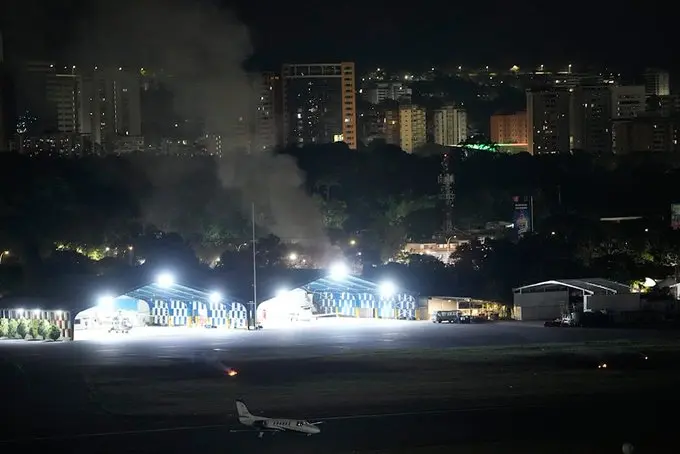
Shortly after the explosions, U.S. President Donald Trump publicly claimed that U.S. forces had carried out a “large scale strike” and that Venezuelan President Nicolás Maduro and First Lady Cilia Flores were “captured” and “flown out of the country.” Major international outlets treating this as breaking news framed Trump’s statement as an extraordinary escalation; however, even early reporting noted that independent verification of Maduro’s location/status was limited and that Caracas had not issued a standard confirmation from the presidential palace at the time those first updates moved.
Venezuela’s government response—amplified quickly through state communications—accused Washington of an “extremely serious” / “gravísima” military aggression targeting both civilian and military locations, and it announced an emergency posture (“Estado de Conmoción Exterior”) while urging national mobilization. In parallel, Venezuelan officials alleged that the true aim of the strikes was resource seizure—specifically Venezuela’s oil and minerals—and said they would seek condemnation through international bodies including the UN Security Council and regional blocs.
Regionally, Colombian President Gustavo Petro posted that Caracas was being bombed and called for urgent multilateral meetings, helping set the tone for the diplomatic fallout that Venezuelan media then echoed and reframed for domestic audiences.
How Venezuelan Media is Reacting
Venezuelan coverage splits sharply along editorial lines, but it largely clusters around three themes: (1) invasion/imperial aggression, (2) uncertainty and pressure over Maduro’s whereabouts, and (3) concrete on‑the‑ground disruption in Caracas and nearby states.
State-aligned framing: “military aggression,” sovereignty, and a mobilization narrative
teleSUR moved quickly to present the overnight events as a sovereignty crisis and a clear act of external aggression, foregrounding formal communiqués and solidarity statements rather than battlefield detail. In its Spanish-language reporting, teleSUR centered the Venezuelan government communiqué that denounces a “gravísima agresión militar” by the United States in Caracas, Miranda, Aragua, and La Guaira, and it emphasized the legal framing: a claimed violation of the UN Charter and an asserted right to self-defense (Article 51). teleSUR’s English-language output extended the same framing by amplifying international allied voices (for example, solidarity networks condemning the strike), repeatedly tying the alleged attack to an attempted regime-change operation and the pursuit of strategic resources.
On broadcast-state infrastructure, Venezolana de Televisión (VTV) functioned as the government’s loudspeaker: it carried the communiqué and highlighted the shift into emergency footing (“Estado de Conmoción Exterior”), the order to deploy national defense structures, and the call for “fusión popular‑militar‑policial” to “guarantee sovereignty and peace.” This is an important media signal in Venezuela: when VTV leads with decrees and patriotic mobilization language, it is cueing audiences that the government wants the events interpreted not as isolated explosions but as a national-security confrontation requiring unity and compliance.
Notably, this state-aligned framing also leans heavily on historical analogies (independence-era resistance and early-20th-century foreign bombardment references) to position the current moment as part of a long anti-imperial continuum. That rhetorical choice matters because it helps justify extraordinary measures at home while seeking sympathy abroad, a pattern teleSUR reinforced by stressing the “international community must denounce” theme rather than dwelling on tactical specifics of the strike.
The status of Maduro: Venezuelan media turns the “capture” claim into a demand for proof
Where the story becomes most volatile inside Venezuela is the gap between Trump’s “captured” claim and Caracas’s immediate inability (or unwillingness) to present Maduro publicly. Here, El Universal (Venezuela) supplied one of the defining early headlines: Vice President Delcy Rodríguez said authorities did not know the whereabouts of Maduro and Cilia Flores and demanded “prueba de vida” from Trump.
This is a classic crisis-communication move that El Universal’s framing makes legible: by publicly demanding proof-of-life, the government simultaneously (a) treats Trump’s claim as credible enough to answer, (b) reframes the story from “capture” into kidnapping/forced removal, and (c) shifts the burden of evidence onto Washington. El Universal’s emphasis on the demand itself—rather than on battlefield mapping—signals that for many Venezuelan readers the political question (“Who controls the presidency right now?”) is at least as urgent as the military one (“What sites were hit?”).
In practice, El Universal’s approach also mirrors what happens in fast-moving uncertainty: it anchors to a named senior official, uses direct quotation (“exigimos prueba de vida”), and ties that to the larger accusation that Caracas was attacked by the United States. The effect is to convert ambiguity into a pressure campaign—domestically to rally supporters, and internationally to force intermediaries (UN, regional governments, even neutral states) to demand clarifications.
On-the-ground, locality-by-locality reporting: the “what people heard and where” approach
In contrast, El Diario (eldiario.com) initially emphasized a ground-level snapshot: where explosions were reported across Caracas and how quickly the reports spread through social platforms. Its early coverage listed neighborhoods such as Altamira, Los Ruices, El Paraíso, La California, Caricuao, and La Pastora among places where detonations were reported, and it labeled the situation as “información en desarrollo,” which is typical of outlets trying to avoid overclaiming before verification.
As official statements emerged, El Diario then pivoted to the institutional response—reporting the declaration of Estado de Conmoción Exterior and summarizing the government’s claim that the blasts affected civilian and military zones in Caracas, Miranda, Aragua, and La Guaira. This two-step progression—first “here’s what people are hearing/seeing,” then “here’s what the state has formally declared”—is a recognizable pattern of independent or semi-independent digital newsrooms operating in crises: it preserves credibility with readers by separating sensory facts from attribution claims.
El Diario also amplified the regional diplomatic angle through its own story on Petro’s call for urgent UN/OAS action, which dovetails with the broader Venezuelan media ecosystem: even outlets focused on local reporting understand that outside pressure can quickly reshape the internal balance of the story.
What This Tells Us About the Venezuelan Media Landscape Right Now
Put together, Venezuelan media reaction is less a single narrative than a stacked set of narratives that audiences can choose from depending on trust and political identity. teleSUR and VTV foreground a state legitimacy story—aggression, sovereignty, mobilization, international law, and resource protection—designed to produce cohesion and justify emergency governance. El Universal spotlights the existential political uncertainty created by Trump’s capture claim and leverages that uncertainty into a public, personalized demand for proof directed at Trump himself. El Diario starts with verifiable locality reports and then layers in the formal decrees, preserving a distinction between “what’s observed” and “what’s alleged.”
Across all three, one through-line stands out: the events are being framed inside Venezuela not as a contained strike but as a geopolitical rupture with immediate consequences for security, governance, and diplomacy—precisely because the “Maduro captured” claim forces every outlet to answer the same question in its own style: “Who is in control, and what happens next?”
Photo: TeleSur/Al Mayadeen