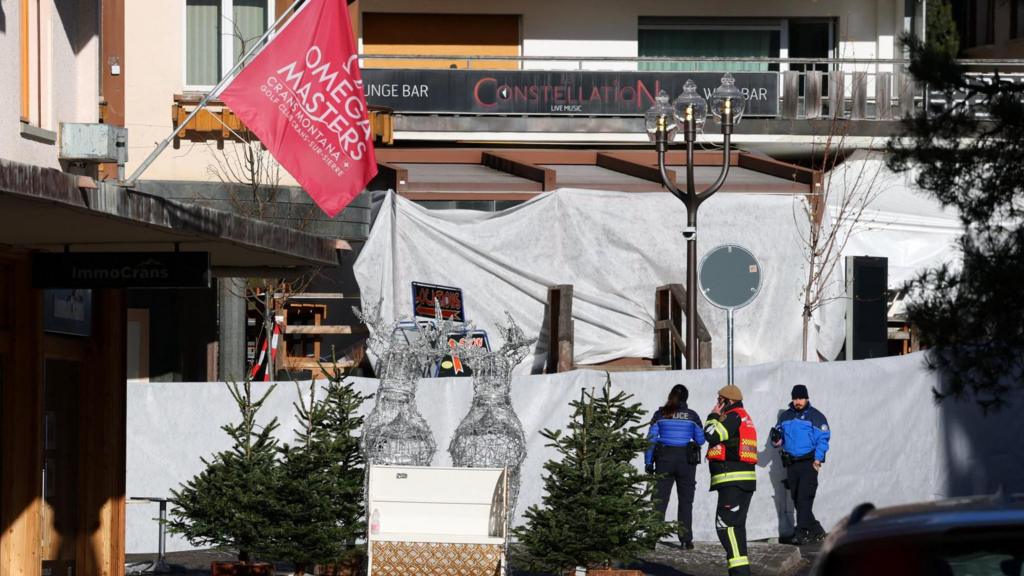
The name Crans-Montana, synonymous in diplomatic history with the dashed hopes of Cypriot reunification, is today synonymous with immediate, physical tragedy. A devastating fire ripped through a crowded luxury bar in the upscale ski resort in the early hours of New Year’s Day, leaving "several dozen" people presumed dead and approximately 100 others injured.
The blaze broke out around 1:30 a.m. local time at Le Constellation, a popular venue located largely below ground level. The bar was packed with hundreds of revelers celebrating the start of 2026 when disaster struck. Early reports from the Italian foreign ministry and local sources suggest the death toll could be as high as 40 to 50 people, though Swiss authorities have not yet provided a finalized figure as recovery efforts continue.
"A Nightmare Scenario"
A massive rescue operation was launched immediately, involving 10 helicopters, 40 ambulances, and 150 first responders. As local intensive care facilities reached capacity, victims suffering from severe burns were airlifted to specialized hospitals across Switzerland, including units in Zurich, Geneva, and Lausanne.
While the exact cause of the disaster remains under investigation, witnesses reported seeing a barmaid with a lit sparkler or a "Roman candle" in a champagne bottle accidentally ignite the wooden ceiling. The fire spread with terrifying speed in the underground space. Police have officially ruled out a terrorist attack, treating the incident as a catastrophic accident.
A no-fly zone has been imposed over the resort to facilitate forensic work, and a family helpline has been established. Swiss officials expressed profound dismay, calling the event a "nightmare" that has turned a moment of global celebration into a national tragedy.
A Symbol of Lost Hope
For the international community, and particularly for the people of Cyprus, Crans-Montana holds a heavy, symbolic weight that has now been compounded by this disaster. Before today's tragedy, the resort was best known as the site of the 2017 Conference on Cyprus—the historical point of reference for the most promising, yet ultimately failed, attempt to reunify the divided island in a generation.
In July 2017, the alpine town hosted high-stakes negotiations bringing together Greek Cypriot President Nicos Anastasiades and Turkish Cypriot leader Mustafa Akıncı. They were joined by the "guarantor powers"—Greece, Turkey, and the United Kingdom—with the European Union acting as an observer.
The negotiations centered on six core areas crucial to a potential settlement: governance and power-sharing, property rights, territorial adjustments, EU relations, the economy, and the pivotal issue of security and guarantees.
The Legacy of 2017
While the 2017 summit saw substantial progress on internal issues, such as the economy and citizenship, the talks ultimately collapsed over the "security and guarantees" chapter. This remains the primary sticking point in the Cyprus Problem to this day.
During those critical days in the Swiss Alps, the divide proved unbridgeable. The Greek Cypriot side demanded a "zero troops, zero guarantees" policy with a clear sunset clause regarding foreign intervention. In contrast, the Turkish side insisted on maintaining a permanent military presence and rights of intervention on the island.
Despite a late-stage intervention by UN Secretary-General António Guterres, who presented the now-famous "Guterres Framework" to bridge the divide, the conference ended in the early hours of July 7, 2017, without an agreement. Guterres described the outcome as a "collective failure."
Since that cold morning in 2017, Crans-Montana has remained the benchmark for the bi-zonal, bi-communal federation model. Today, as smoke rises over the resort, the town is once again the center of international sorrow—no longer just for a diplomatic opportunity lost, but for the lives extinguished in the dawn of the new year.
Photo: BBC News