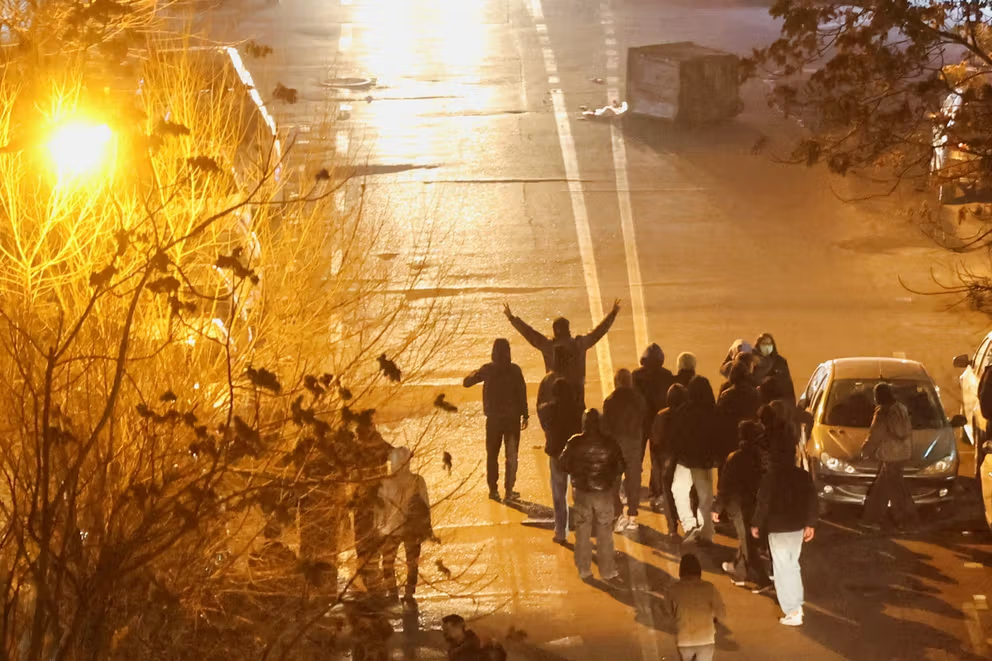
The political crisis in Iran has intensified as nationwide protests enter their nineteenth day, marked by a week-long internet blackout and reports of a lethal crackdown unprecedented in recent history. With communication lines largely severed to obscure the scale of the unrest, the international community is mobilizing. The United States has formally requested an emergency session of the United Nations Security Council to address the deteriorating human rights situation, signaling a shift from diplomatic observation to active intervention regarding the turmoil in Tehran.
According to live coverage and reports monitored by Iran International and BBC Persian, the suppression of dissent has reached critical levels, with the death toll reportedly surging into the thousands. These outlets highlight that despite the regime’s attempts to stifle information, credible reports have emerged showing security forces utilizing military-grade technology against their own population. The coverage indicates a synchronized global reaction, ranging from diaspora rallies in Frankfurt and Washington D.C. to diplomatic condemnations and urgent travel warnings issued by nations such as India and New Zealand.
A significant focal point of the developing narrative involves the stance of the U.S. administration regarding potential alternative leadership. In an interview with Reuters, President Donald Trump addressed the role of exiled Crown Prince Reza Pahlavi. While Trump described Pahlavi as a "very respectable person," he expressed uncertainty regarding the Prince's level of acceptance within Iran. Trump clarified that while he is not currently orchestrating a regime change led by Pahlavi, he would "certainly not oppose it" if the Iranian people accepted his leadership. Conversely, Republican Senator Lindsey Graham offered a more direct endorsement during a meeting with the Prince, telling Pahlavi that he believes "help is on the way."
Inside Iran, the regime is projecting a mix of denial and military aggression. Abbas Araghchi, Iran's Foreign Minister, told Fox News that the Islamic Republic has "no plans" to execute detained protesters, directly contradicting fears raised by human rights organizations. However, the U.S. State Department has accused the regime of treating citizens like "enemy combatants," confirming the use of surveillance drones to track and arrest peaceful demonstrators. Amidst this tension, Iran’s airspace was briefly closed on Wednesday night before reopening Thursday morning, a move that prompted India to urge its 10,000 citizens in the country to evacuate immediately.
The humanitarian cost of the crackdown appears staggering. Amnesty International has cited government statistics suggesting the death toll may have reached 2,000, calling for immediate diplomatic action to end the impunity. Political reverberations are being felt globally; South Korea's "National Reform Party" issued a statement comparing the Islamic Republic’s violence to the brutal suppression of the 1980 Gwangju uprising, predicting that such violence signals the regime's desperation. Echoing this sentiment, former hostage Kylie Moore-Gilbert described the recent bloodshed as the actions of a "dying regime," suggesting that the collapse of the system is now a question of time rather than possibility.
Photo: Iran International