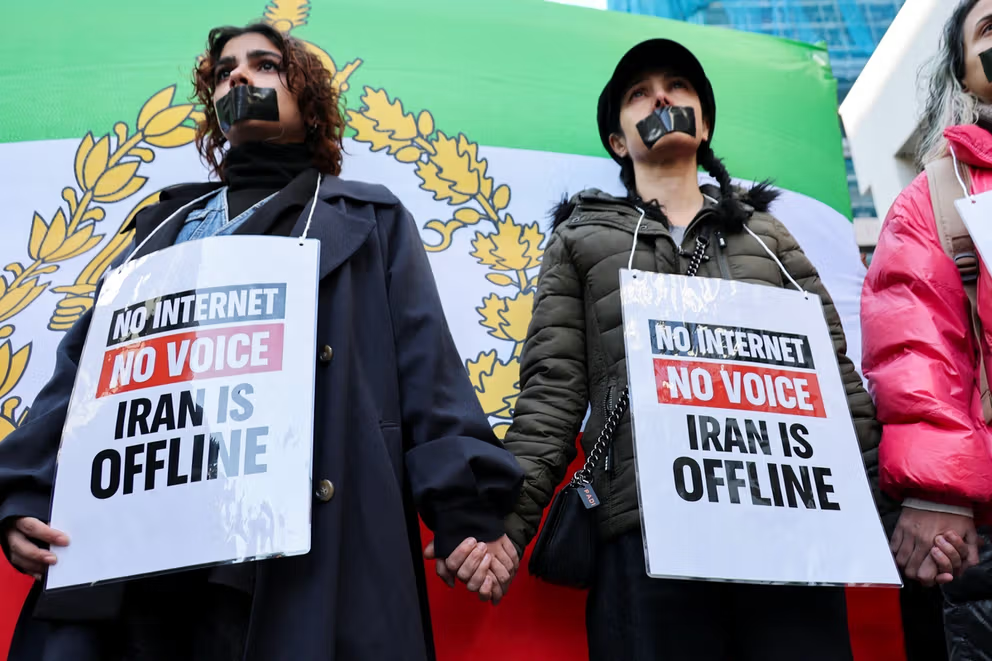
Iran is tightening control over domestic cyberspace through a new state-run intranet, raising fears that millions of citizens could become digitally isolated amid the longest internet blackout since the country’s 1979 revolution.
According to a report by Iran International, the move comes in the wake of a nationwide communications shutdown that began on January 8, obscuring what medics and insiders describe as the deadliest governmental crackdown in nearly fifty years. The blackout coincided with waves of anti-government protests that spread across the country, prompting security forces to unleash what witnesses call unprecedented levels of violence.
Neda Bolourchi, executive director of the Washington-based Public Affairs Alliance of Iranian Americans (PAAIA), compared the emerging system to the digital isolation strategies of North Korea. “It will be blocking off Iran,” she warned, emphasizing that the government’s new intranet could permanently sever most Iranians from the global web. The PAAIA, an advocacy group that pushes for democratic reform and internet freedom, accused Tehran of weaponizing connectivity as a means of population control.
Citing officials and medical sources, Iran International reported that around 12,000 people were killed during the two days following the nationwide shutdown on January 8. Supreme Leader Ali Khamenei has since admitted that “several thousands” died, while doctors describe those days as the most violent period in the Islamic Republic’s 47-year history. The near-total data blackout has made independent verification of casualties nearly impossible.
Bolourchi said the current shutdown remains severe but not absolute. Some limited access is being selectively restored to sustain essential functions such as banking and state operations. “We’re getting reports that landlines are sporadically available and that some of the throttling has been reduced,” she said, explaining that these minor openings are driven by economic necessity, not leniency. The regime, she added, cannot completely cut off digital connectivity without crippling its own infrastructure.
Meanwhile, satellite internet access—once the last lifeline for many Iranians—has come under aggressive suppression. Authorities have reportedly deployed high-powered jamming equipment against Starlink networks and launched house-to-house operations to confiscate satellite receivers. The devices, visible by design, have become dangerous to own as the security apparatus broadens charges historically reserved for “enemies of the state” to include those trying to stay connected.
Experts warn that the scope and duration of the blackout reveal a deeper transformation. Unlike previous temporary shutdowns that collapsed under economic strain, this one appears to mark a structural decoupling of government systems from public internet access. Analysts say this paves the way for a fully monitored, state-filtered intranet that could function independently from the open web.
Bolourchi stressed that Western nations—especially the United States—still have tools to push back. Congress has previously approved $15 million annually for technologies supporting secure communications and satellite connectivity inside Iran. Yet she lamented bureaucratic inertia: “A lot could have been done over the past year that would be helping the people of Iran right now. Instead, we’re always in a reactive position.”
As thousands of Iranians in the diaspora continue their rallies—from Washington to Tokyo—to voice solidarity with the protesters back home, Tehran’s accelerating digital isolation strategy signals a new and far more enduring era of control over its citizens' capacity to speak, see, and be seen.
Photo: Iran International