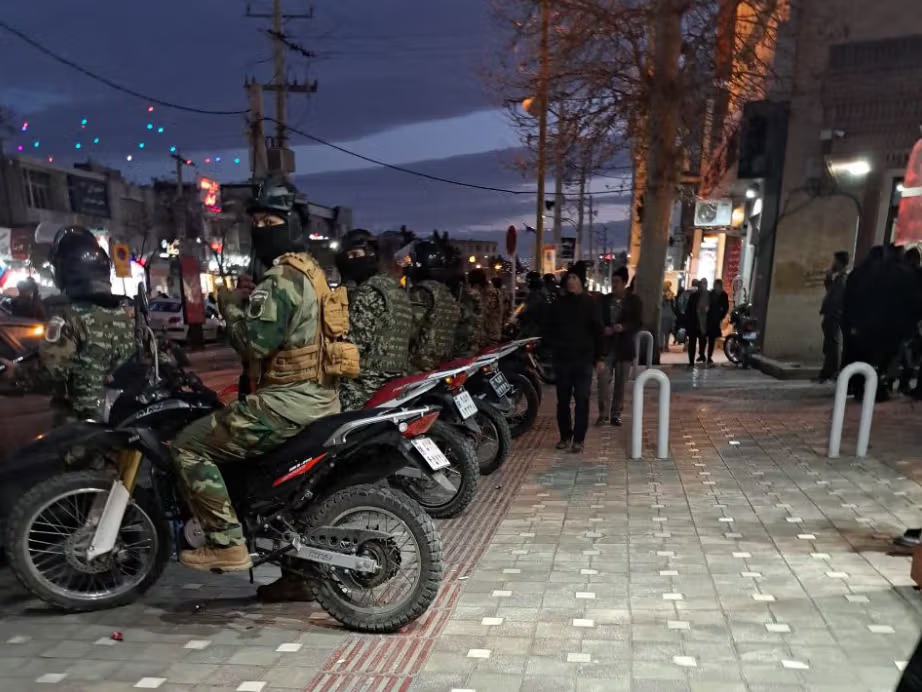
As nationwide protests in Iran stretch into their seventh day, the divide between the Islamic Republic’s leadership and the populace has deepened. Supreme Leader Ali Khamenei has explicitly categorized demonstrators as "rioters" and ordered their suppression, while President Masoud Pezeshkian admitted to the arrest of bazaar merchants, blaming foreign influence for the unrest.
Regime Response: The Iron Fist and the "Foreign Plot"
In his first direct comments since the uprising began seven days ago, Supreme Leader Ali Khamenei struck a harsh tone. Addressing the nation, he labeled the protesters "mercenaries incited by enemies" who are chanting slogans against Islam. Drawing a sharp line between "legitimate protest" and "sedition," Khamenei stated, "We talk to protesters, but there is no point in talking to rioters. Rioters must be put in their place." He vowed that the regime would not back down, asserting they would bring the "enemy to their knees."
President Masoud Pezeshkian, attempting to manage the escalating crisis, met with officials from the Ministry of Agriculture. While he echoed the Supreme Leader’s narrative that "foreigners are inciting insecurity," he also confirmed that security forces have detained members of the bazaar guilds—a critical economic sector that has joined the strikes. "We will not allow anyone to create insecurity," Pezeshkian said, though he added that the government would try to solve the guilds' problems speedily to prevent further friction.
Rising Toll: Deaths, Injuries, and Arrests
The crackdown on the ground has intensified. Reports confirmed by Iran International indicate that at least 44 protesters have been wounded by live ammunition and birdshot in the past six days. The injuries, sustained by victims aged 14 to 35, have occurred in cities including Azna, Lordegan, and Marvdasht.
Tragically, the identities of specific victims are emerging. Ahmanreza Amani, a 28-year-old law trainee who ranked first in the 2024 bar exam entrance for veterans, was shot and killed by security forces in Azna on Tuesday. Similarly, Shayan Asadollahi, a 28-year-old protester and avid Persepolis FC fan, was killed in the same city after being targeted by security forces in military vehicles.
Security forces are reportedly conducting sweeps in hospitals to arrest the wounded. A source confirmed that between December 28 and January 1, over 76 people arrested in connection with the protests were transferred to Tehran’s notorious Evin Prison.
International Outcry and Regional Watch
The international community is reacting with growing alarm. The German Ministry of Foreign Affairs, in a statement to Iran International, expressed "deep concern" over the violence and called on Tehran to respect fundamental rights. Similarly, Mai Sato, the UN Special Rapporteur on Human Rights in Iran, warned against the use of lethal force, noting reports of at least eight deaths.
Tensions with the United States have spiked following a stern warning from President-elect Donald Trump. Trump stated that if the Islamic Republic uses lethal force against peaceful protesters, the U.S. is "armed and ready" to intervene to save them. Major media outlets, including The Economist and The Washington Post, are analyzing this as a potential turning point, suggesting that the combination of internal economic collapse and external threats from the U.S. and Israel could push the situation into uncharted territory.
Regionally, neighbors like Saudi Arabia, the UAE, and Iraq are watching with caution, balancing their security concerns with the potential geopolitical shifts a weakened Iranian regime might bring.
Domestic Resistance Coalesces
Despite the threats, the opposition front is solidifying. Prince Reza Pahlavi issued a call for citizens in Tehran and other major cities to "conquer the streets" and create massive gridlocks to exhaust the regime's suppression machine.
Inside Iran, a group of 17 prominent civil and political activists—including figures like Jafar Panahi, Nasrin Sotoudeh (via foundation), and Mostafa Tajzadeh—released a joint statement declaring that a "peaceful transition from the Islamic Republic" is now a necessity that cannot be suppressed. They warned security forces that violence against citizens would be recorded as a crime in history.
Solidarity is also coming from public figures. The Association of Families of Flight PS752 Victims issued a statement supporting the protesters' call for regime change. Meanwhile, footballer Shahriar Moghanlou posted an emotional message on social media, writing, "We are doing the hardest work in the world... we are both sad and hopeful."
Economic Desperation
The protests, initially sparked by economic collapse, continue to be fueled by inflation over 40% and a plummeting currency. In a bid to quell labor unrest, the parliament and government have hurriedly promised wage increases of up to 40% for civil servants and workers in the upcoming budget. However, labor activists like Fouad Keykhosravi have dismissed these promises as "delay tactics," arguing that the regime lacks the economic capacity to solve the crisis and is merely trying to buy time to prevent the working class from fully joining the political uprising.
Photo: Iran International