Iran faces unprecedented popular revolution as millions take to streets in coordinated mass protest, defying regime's brutal crackdown, communications blackout, and threats of death sentences for demonstrators.
On the twelfth day of nationwide upheaval, Iran witnessed what may represent the most coordinated and simultaneous mass uprising in the Islamic Republic's history. In response to a specific call issued by exiled Crown Prince Reza Pahlavi for protests at 8 p.m. local time Thursday night, neighborhoods across the country erupted in unison—a critical distinction that signals a fundamental shift in the nature of Iran's political crisis. For the first time, a call to action produced precisely coordinated nationwide responses across more than 170 cities, marking not merely scattered discontent but organized, synchronized resistance to Supreme Leader Ayatollah Ali Khamenei's hardline regime.
The significance of this coordinated uprising lies in its unprecedented character. Experts note that in past protest movements, external calls for action often yielded sporadic and fragmented responses. Thursday night's demonstrations proved radically different, with demonstrators appearing simultaneously in multiple cities and provinces, chanting identical slogans and responding to the same directive. This convergence of timing and purpose has fundamentally altered Iran's political landscape, establishing for the first time a recognizable opposition focal point and center of mobilization that the regime must now confront as an organized force rather than scattered malcontents.
The Flames of Revolution: Dramatic Scenes from Thursday Night's Massive Mobilization
Millions of Iranians filled streets across the country on Thursday, the 12th day of nationwide protests. In videos sent to Iran International before the communications blackout, dramatic scenes emerged showing demonstrators setting ablaze symbols of the regime's authority. The footage revealed burning signs and statues of late Quds Force commander Qassem Soleimani—a controversial figure whose assassination by the United States in 2020 the regime had memoralized throughout the country. The destruction extended to government vehicles, buildings, and vehicles belonging to security forces, with fires erupting in multiple neighborhoods as protesters asserted their defiance through acts of symbolic and physical resistance.
Witnesses reported that bonfires blazed through Tehran and provincial cities, with thousands of demonstrators gathering around the flames to shout revolutionary slogans. Chants of "Death to the dictator" and "Death to the Islamic Republic" echoed through streets, while others invoked the pre-revolutionary era with cries of "Long live the Shah" and "This is the last battle, Pahlavi will return." In what may represent the most striking development, demonstrators in some locations openly praised the exiled crown prince, signaling a dramatic shift from demands for reform toward explicit calls for regime change and the restoration of monarchy—a position previously considered politically marginal in Iranian society.
The scale of Thursday night's demonstrations far exceeded previous mobilizations. Tens of thousands gathered simultaneously on Tehran's major thoroughfares, while comparable crowds assembled in secondary cities and towns nationwide. The footage that emerged before authorities severed internet connectivity documented what participants and observers described as the most extensive popular uprising in response to a specific opposition call since the 1979 revolution that established Islamic rule.
Desperate Measures: The Regime's Total Communications Blackout
As the spontaneous uprising escalated Thursday evening, Iranian authorities implemented one of the most comprehensive digital shutdowns in the Islamic Republic's history. Internet connectivity collapsed to approximately 1 percent of normal traffic, effectively isolating Iran from the outside world and crippling citizens' ability to document, communicate about, or coordinate further demonstrations. The blackout extended beyond internet services—landline telephone networks were similarly disabled, international calling became impossible, and authorities cancelled all flights in and out of the country, essentially sealing Iran's borders to external observation and internal escape.
The communications blackout served a dual purpose in the regime's crisis management strategy. First, it prevented real-time documentation of the escalating crackdown, limiting the world's ability to witness security force actions against demonstrators. Second, it aimed to sever the organizational and inspirational connectivity that had powered Thursday night's unprecedented coordination. By eliminating internet and phone services, authorities sought to prevent activists from organizing further demonstrations and broadcasting videos of government violence—videos that, in previous protest cycles, had galvanized broader participation and international attention.
However, the blackout simultaneously exposed the regime's desperation. The decision to sever all communications represented an extraordinary acknowledgment that normal security measures had failed to suppress the uprising. Exiled Crown Prince Pahlavi warned that this communications severing would provide "cover for security forces to target protesters" without international witnesses, effectively allowing what human rights groups characterized as a potential massacre under conditions of enforced darkness and information isolation.
UN and Global Alarm: International Community Responds to Escalating Violence
The mounting death toll and increasingly brutal security response prompted urgent international condemnation. UN Human Rights Chief Volker Türk issued a statement on Friday expressing deep concern over the unfolding crisis. In formal remarks, Türk declared: "I am deeply disturbed by reports of violence during nationwide protests in Iran over the past 13 days, including reported deaths and destruction of property. The right to peaceful protest, as enshrined in international law, must be protected. All deaths should be promptly, independently, and transparently investigated. Those responsible for any violations must be held to account in line with international norms and standards."
Türk's statement specifically condemned the communications blackout as a human rights violation, noting that shutting down internet and phone services "undermine freedom of expression and access to information, as well as impacting on the work of those documenting human rights violations, and access to essential and emergency services." The UN official's intervention represented the first formal statement from the international human rights establishment regarding the rapidly deteriorating situation inside Iran.
Press freedom advocates similarly mobilized in response to the blackout. The Committee to Protect Journalists issued an urgent call for Iran to restore internet access, characterizing the shutdown as part of a pattern of regime tactics designed to "silence dissent and obstruct reporting." The CPJ statement emphasized that "such tactics violate freedom of expression and the public's right to know," and called on "the international community must hold Iran accountable and press it to uphold international human rights obligations."
Horrifying Evidence: Videos Document Apparent Massacre in Western Tehran
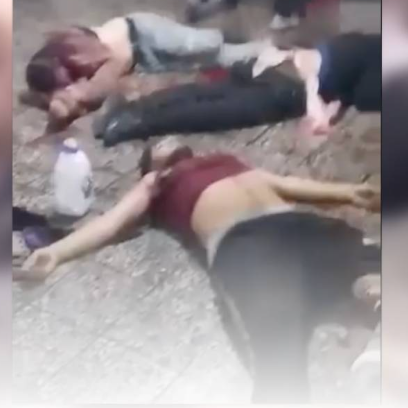
A disturbing video circulating on social media shows several people lying motionless on the ground following massive protests held on Thursday night in Fardis, 25 miles west of Tehran. The footage was reviewed and authenticated by Factnameh, Iran's prominent fact-checking platform, which confirmed the videos were authentic, newly recorded, and had not previously appeared online. At least seven individuals could be seen in the footage lying on the ground, with some appearing to be in critical condition, though no official confirmation of casualties during Thursday's crackdown has been released by Iranian authorities.
The Factnameh authentication is particularly significant given the comprehensive communications blackout. The platform's verification that these videos documented newly-recorded events during Thursday night's demonstrations provides some of the first verifiable evidence of the security forces' lethal response. Additionally, Factnameh documented at least one additional video from the same location showing demonstrators under live fire, suggesting a sustained pattern of armed suppression rather than isolated incidents.
These horrifying scenes from Fardis underscore the lethal nature of the regime's response to the uprising. While the exact death toll remains contested due to information restrictions, the authenticated videos provide unambiguous evidence of multiple casualties from security force action.
The Reckoning Begins: Death Toll Climbs as Casualties Mount
The human cost of the twelve-day uprising continues mounting at an alarming rate. Death toll figures vary depending on the source, reflecting both the information blackout and the difficulty of independent verification under conditions of extreme government suppression. According to the US-based Human Rights Activists News Agency (HRANA), at least 45 demonstrators have been killed since the unrest erupted on December 28. The Norway-based Iran Human Rights organization independently confirmed comparable figures, documenting at least 45 deaths through verified reports and video footage.
The mortality pattern reveals that security forces have employed lethal force systematically rather than sporadically. The deadliest single incident occurred in Malekshahi, Ilam province, where security forces opened fire on protesters on January 2, killing at least five demonstrators and wounding approximately thirty others. Video documentation from Malekshahi Hospital showed scenes of chaos and numerous wounded civilians, providing stark evidence of the intensity of the military-style assault on unarmed demonstrators.
The identified victims include victims of strikingly diverse ages and backgrounds. At least three children were killed during the eight-day period through January 5, with teenagers as young as 14, 15, and 17 among the deceased. The PMOI/MEK organization released verified names of 31 martyrs by January 5, confirming that the uprising has claimed victims spanning multiple generations, from teenagers to individuals in their late 30s. The Guardian reported that over 40 minors have been arrested during the protests, suggesting that security forces have targeted young people with particular intensity.
The Imprisonment Machine: Over 2,270 Detained as Regime Expands Crackdown
Accompanying the lethal violence, the regime has initiated a systematic mass arrest campaign designed to suppress future demonstrations and extract information about protest organization. According to HRANA, more than 2,200 individuals have been detained in at least 285 locations across the country since demonstrations began. This figure may significantly underestimate the actual number of arrests given the information blackout and the regime's history of concealing detention statistics.
The detention campaign encompasses a broad demographic cross-section of Iranian society. Teenagers and young adults comprise a substantial portion of those arrested, reflecting the security forces' apparent strategy of removing potential future protest leaders from circulation. Additionally, middle-class professionals, merchants from Tehran's traditional bazaar, and students have been detained, suggesting that the uprising has penetrated class boundaries that previous protest movements had not successfully crossed.
The detention phase portends even more grim developments ahead. Tehran's public and revolutionary prosecutor, Ali Salehi, explicitly warned on Friday that authorities would pursue the most severe legal charges against detained demonstrators. Salehi announced that those accused of arson, destruction of public property, and armed clashes with security forces would be charged with moharebeh—a concept translated as "waging war against the state"—a charge that carries a mandatory death sentence under Iranian law. His statement represented a regime announcement that it intends to prosecute large numbers of detained protesters as capital offenders, effectively signaling a potential wave of executions ahead.
Khamenei's Defiant Response: Regime Doubles Down as Supreme Leader Rejects Compromise
Faced with the largest coordinated popular uprising in recent memory, Ayatollah Ali Khamenei refused to retreat or negotiate. Instead, Friday morning the 86-year-old Supreme Leader delivered a televised address from his residence in Tehran that signaled the regime's intention to intensify repression and reject any accommodation with demonstrators. In remarks broadcast across state media, Khamenei displayed evident strain and anger, rejecting any notion of compromise while doubling down on accusations that the uprising represented a foreign conspiracy orchestrated by the United States.
Khamenei's core rhetorical strategy involved displacing responsibility for the uprising away from Iran's economic collapse and toward external enemies. "The rioters are damaging their own neighborhoods, burning their own streets, destroying public property—all to please the president of another nation," Khamenei declared, referring explicitly to President Donald Trump. He expanded these accusations, claiming that Trump's "hands are tainted with the blood of over a thousand Iranians," referencing the June 2024 conflict between Iran and Israeli forces that had resulted in Iranian casualties.
Significantly, Khamenei's address included no acknowledgment of the economic catastrophe that triggered the initial protests on December 28. The collapse of Iran's currency to 1.4 million rials per dollar, the consequent inflation devastating ordinary Iranians' purchasing power, and the merchant class's desperation over their inability to sustain businesses—none of these economic realities received mention from the Supreme Leader. Instead, Khamenei presented the entire uprising as a foreign-orchestrated conspiracy designed to humiliate Iran and destroy the Islamic Republic.
The most striking element of Khamenei's address, however, was his unambiguous rejection of restraint or compromise. "We will not back down. The rioters must be put in their place," he declared, signaling to security forces that intensified violence had regime approval at the highest level. His words represented a clear authorization for escalated repression, effectively instructing the Islamic Revolutionary Guard Corps and police to expand lethal force against demonstrators.
Supporting Khamenei's hardline stance, Iran's judiciary chief, Ebrahim Raisi (also referred to as Mohi-Ejei in some reports), issued statements pledging that consequences for protesters would be "decisive, maximum and without any legal leniency," explicitly rejecting any judicial mercy or clemency considerations. These parallel statements from both the Supreme Leader and judicial chief conveyed to the regime's security apparatus a unified message: escalate violence, conduct mass arrests, and prepare death sentences for detained demonstrators.
Trump's Intervention: The Crown Prince's Appeal and American Pressure on Iran's Calculations
The unprecedented coordination of Thursday night's demonstrations appears directly linked to Crown Prince Reza Pahlavi's explicit call for organized protest. Pahlavi, whose terminally ill father was forced into exile before the 1979 revolution that established Islamic rule, has emerged as the focal point for regime opponents seeking organized leadership. Speaking to Iran International and posting on social media platform X, Pahlavi declared: "What turned the tide of the protests was former Crown Prince Reza Pahlavi's calls for Iranians to take to the streets. This is exactly why the internet was shut down: to prevent the world from seeing the protests."
Significantly, Pahlavi explicitly invoked and appealed to President Donald Trump for military intervention. In a post on X on Friday, Pahlavi issued an urgent plea: "Mr. President, this is an urgent and immediate call for your attention, support, and action. Last night you saw the millions of brave Iranians in the streets facing down live bullets. Today, they are facing not just bullets but a total communications blackout. No Internet. No landlines."
Pahlavi's appeal referenced Trump's previous warnings that the United States would respond militarily if Iranian forces kill peaceful demonstrators. Trump had declared on multiple occasions that the U.S. is "locked and loaded" and prepared to respond "very hard" if the regime continues killing protesters. Pahlavi effectively leveraged these statements, telling Trump: "You have proven and I know you are a man of peace and a man of your word. Please be prepared to intervene to help the people of Iran.
The crown prince's explicit request for American military intervention represented a dramatic escalation in the nature of the opposition challenge. Unlike previous Iranian protest movements that emphasized nationalist credentials and indigenous Iranian origins, the current uprising has openly sought international military support for regime change. Pahlavi similarly appealed to European leaders to restore communications and monitor the crackdown, positioning Western intervention as central to the opposition strategy.
Trump's response remained characteristically ambiguous. While reiterating threats against Iran's leadership, Trump simultaneously distanced himself from any support for Pahlavi or planning for post-regime governance. "I have nothing to do with him, but we will support the people and we will support them very strongly," Trump stated, suggesting he would provide protection against lethal force but not endorse Pahlavi's potential leadership of a successor government.
The Prosecutor's Death Sentence Warning: Moharebeh Charges Portend Mass Executions
In one of the most chilling developments of the crisis, Tehran's prosecutor announced Friday that detained demonstrators would face charges carrying mandatory capital punishment. Tehran's public and revolutionary prosecutor, Ali Salehi, specifically identified "moharebeh" charges—Islamic Republic terminology for "waging war against the state"—as the legal mechanism through which the regime would pursue the death penalty against large numbers of arrested protesters.
Salehi's announcement explicitly stated that those accused of arson, destruction of public property, and "armed clashes with security forces" would be prosecuted under moharebeh statutes. "Our response will be deterrent, and their ruling is moharebeh," Salehi declared. Under Iranian law, moharebeh convictions carry mandatory death sentences, making Salehi's announcement essentially a public notification that the regime intends to execute substantial numbers of detained demonstrators.
The invocation of moharebeh charges represents a legal escalation beyond those employed in previous protest cycles. In the 2009 Green Movement and 2022 "Woman Life Freedom" protests, the regime prosecuted numerous activists but typically employed somewhat less severe charges. The decision to pursue moharebeh—a charge theoretically reserved for those engaged in armed rebellion against the state—signals the regime's assessment that the current uprising poses an existential threat requiring maximum legal deterrence.
The Revolutionary Guards' Warning: "Unacceptable" and Threats to Demonstrators
The Islamic Revolutionary Guard Corps' intelligence organization added its own warning to Thursday's crackdown escalation, issuing a statement that characterized the continuation of the protests as fundamentally "unacceptable." The IRGC intelligence arm declared: "We warn that the continuation of this situation is unacceptable," adding threats that the blood of those killed in what the organization described as "terrorist incidents" would be "on the hands of their planners."
The IRGC statement notably constructed a framework in which ongoing demonstrations themselves—regardless of whether they involve violence—constitute terrorism and planning against the state. By characterizing organizers of peaceful protest as "planners" of terrorism, the intelligence organization provided legal and rhetorical justification for targeting even non-violent opposition figures and protest coordinators with charges similar to those employed against armed combatants.
The IRGC intelligence statement concluded by establishing "a red line" around what it termed "achievements of the Islamic Republic and public security," effectively announcing that any further demonstrations would be treated as violations of regime red lines justifying the full spectrum of security force responses.
The Unraveling Economy and Merchant Class Alliance: What Sparked Twelve Days of Upheaval
The current uprising's origins lie in the catastrophic economic deterioration that has rendered Iran's currency essentially worthless internationally and devastated the purchasing power of ordinary Iranians and merchant communities. The rial collapsed to 1.4 million per dollar in December 2025—a decline that transformed the economic calculations of hundreds of thousands of Iranian families and businesses overnight. This currency collapse followed years of international economic isolation, sanctions imposed over Iran's nuclear program and regional proxy activities, and the regime's mismanagement of resources.
The demonstrations began on December 28 when Tehran's merchant class—traditionally a conservative social force—initiated shop closures in the capital's famous bazaar to protest economic conditions and the government's failure to stabilize the currency. This merchant uprising proved historically significant because Iran's traditional bazaar merchants had historically provided a pillar of support for clerical rule, their cooperation essential to the regime's economic functioning. The decision of this traditionally regime-aligned class to openly challenge government policy signaled a fundamental breakdown in the coalition supporting Islamic rule.
From this initial merchant-driven action, the protests rapidly expanded to encompass young people, students, and working-class Iranians who faced even more dire economic circumstances than merchants. The geographical spread of the protests from Tehran across more than 170 cities within twelve days demonstrated that economic despair had penetrated far beyond the capital's merchant community, affecting broad swaths of Iranian society across diverse regions and socioeconomic backgrounds.
Notably, the initial economic grievances evolved substantially by the protest movement's second week. While economic devastation provided the spark, the slogans and demands captured in videos from later protest days reveal demands for regime change and restoration of monarchy—positions that transcend mere economic complaint and represent fundamental political rejections of clerical rule. Expert analysis suggests that the economic trigger unleashed deeper currents of Iranian discontent with Islamic Republic governance that had accumulated over decades.
The Emerging Opposition Center: Reza Pahlavi and the Transformation of Iran's Political Crisis
Perhaps the most consequential development emerging from the twelve-day uprising involves the emergence of Reza Pahlavi as an organized opposition focal point. Prior to Thursday night's coordinated demonstrations, Pahlavi functioned primarily as a symbolic figure—the exiled son of the Shah, expressing opposition to clerical rule but lacking demonstrated organizational capacity or significant popular mobilization ability. The successful coordination of Thursday night's simultaneous nationwide protests in response to Pahlavi's specific call transformed his political status fundamentally.
Expert analysts have characterized this development as representing a qualitative shift in Iran's political dynamics. As one observer noted: "The significance of Thursday night lies not in raw numbers alone, but in coordination and credibility. Many external calls in the past produced little or nothing. This one did not. For the first time, a call issued for a specific hour was answered across the country. Demonstrations began simultaneously at the designated time, offering clear evidence of collective response rather than scattered unrest. That precision, and the response to it, marked a qualitative shift in Iran's political dynamics."
The question of opposition leadership has historically plagued Iranian movements for change. In the 2009 Green Movement and 2022 "Woman Life Freedom" demonstrations, protesters articulated grievances and demanded change but lacked identifiable leadership structures or succession alternatives to the regime. The emergence of Pahlavi as a demonstrated mobilization center potentially addresses this historical deficit. According to Iran analysts, "The question is no longer whether Iranians are searching for an alternative or whether a leader could emerge. Both questions have been settled. A focal point now exists, and the regime is forced to reckon with it."
This transformation of Pahlavi from symbolic figure to operational opposition leader has profound implications. "From this moment on, Iranian politics operates under new constraints. The state must now respond not to spontaneous unrest, but to an identifiable center of mobilization. History shows that regimes can survive protests. They struggle far more to survive leaders."
An Unprecedented Crisis for the Islamic Republic
The twelve-day uprising in Iran represents the most serious threat to clerical rule since the 1979 Islamic Revolution established the regime. The convergence of multiple destabilizing factors—economic collapse reaching historically unprecedented levels, a traditionally regime-aligned merchant class in open rebellion, unprecedented coordination of nationwide demonstrations, and the emergence of an identifiable opposition leadership in Pahlavi—creates a conjuncture qualitatively different from previous Iranian protest cycles.
The regime's response—employing lethal force against demonstrators, severing all communications, threatening mass executions through moharebeh charges, and explicitly rejecting any accommodation or compromise—suggests a state apparatus that has concluded that institutional survival requires maximum repression. The mounting death toll, expanding detention campaigns, and prosecutor's announcements of imminent capital prosecutions signal that the crisis will intensify rather than de-escalate in coming days.
Critically, the intervention of international actors—particularly the explicit threat of American military support for demonstrators combined with Pahlavi's emergence as organized opposition leadership—introduces geopolitical dimensions absent from previous Iranian protest movements. The coming hours and days will determine whether the regime can suppress the uprising through enhanced violence and information control, or whether the coordination demonstrated Thursday night will persist and expand into a sustained movement that the Islamic Republic cannot contain through conventional security methods.
* A Necessary Explanation
The Levant Files is publishing the cover image as a rare exception because of its historical and evidentiary value, not to sensationalize violence or dehumanize its subjects. The editorial team normally avoids explicit or inhuman imagery, but in this moment judges that the public’s right to see credible visual proof of state brutality outweighs that policy.
The image comes from a disturbing video circulated on social media showing several people lying motionless on the ground after massive protests on Thursday night in Fardis, about 25 miles west of Tehran. At least seven people are visible on the ground, and the condition of some appears critical, although there has been no official confirmation of casualties from that night’s crackdown. The footage has been reviewed by Factnameh, an Iranian fact‑checking platform, which has assessed the videos as authentic, newly recorded, and not previously published online. Factnameh also reports at least one additional video from Fardis that shows demonstrators coming under live fire, reinforcing evidence that security forces used lethal force against protesters.
Borrowed from Iran International, this image is presented with careful context and clear sourcing to document an unfolding crime against civilians and to resist denial and erasure. The Levant Files publishes it to bear witness and to record the human cost of repression in the historical record, while remaining mindful of the dignity of those depicted.