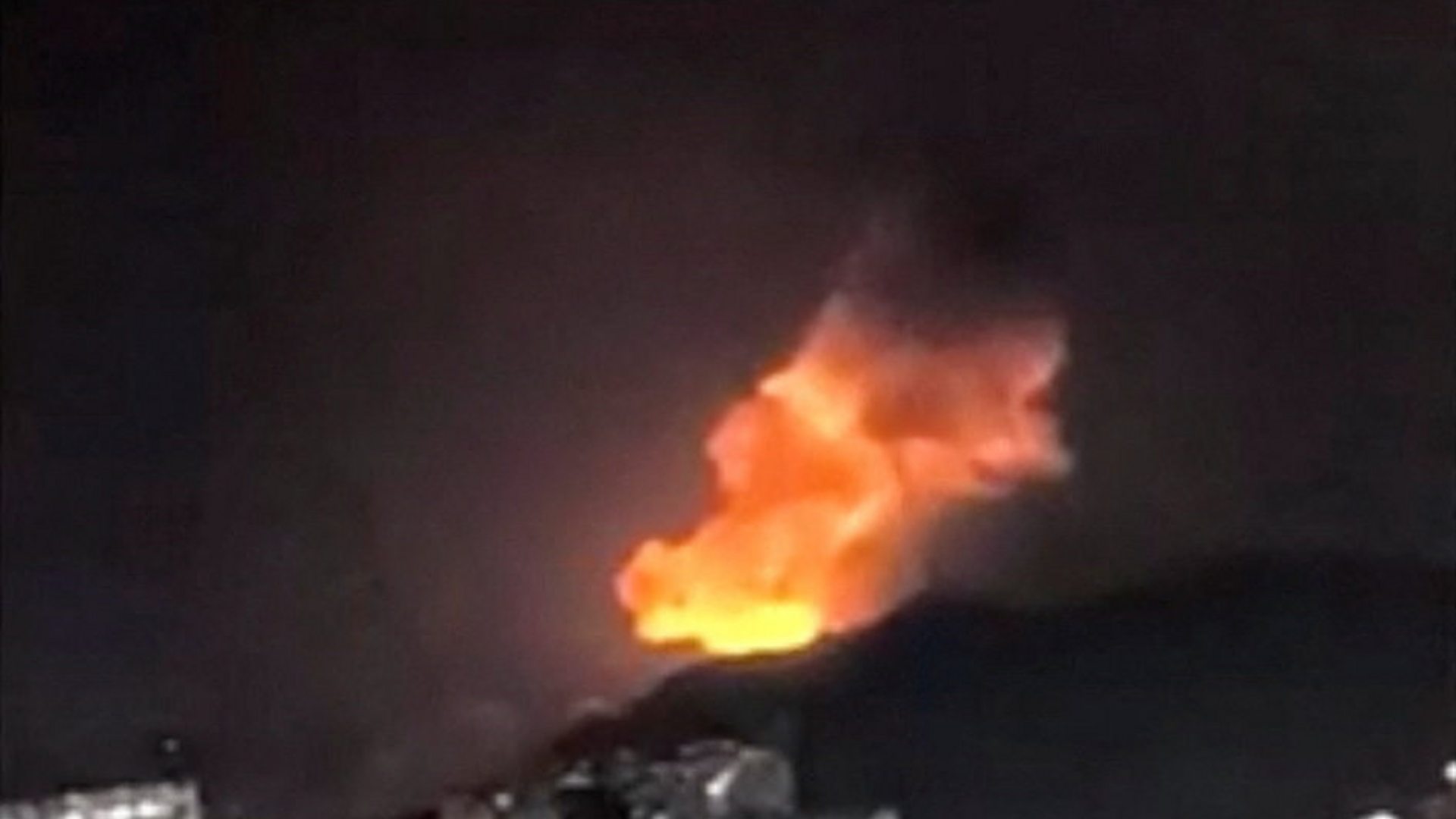
A reported U.S. “large-scale strike” on Venezuela early Saturday, followed by claims that President Nicolás Maduro and his wife were captured and flown out of the country, triggered a swift and angry reaction across parts of the Middle East, led by Iran and echoed by voices in Turkey that warned the operation could widen instability and erode international norms of sovereignty.
In Caracas, residents reported explosions and low-flying aircraft around 2 a.m. local time as the Venezuelan government accused Washington of hitting civilian and military sites in and around the capital and declared a nationwide emergency, describing the events as “military aggression.” U.S. President Donald Trump said on social media that American forces had carried out the strike and that Maduro and his wife had been capured, though details remained limited and some elements were still unfolding in real time. [
Iran Calls the Operation “Aggression” and Urges U.N. Action
Iran, one of Caracas’s closest strategic partners, issued one of the sharpest regional condemnations, framing the attack as unlawful force against a sovereign state. Iran’s Foreign Ministry, according to accounts of its statement, described the strike as a “gross violation” of Venezuela’s sovereignty and territorial integrity and said it breached core principles of the U.N. Charter, explicitly urging international organizations—especially the U.N. and Security Council—to act to halt what it called illegal aggression and to hold perpetrators accountable.
Iranian media also amplified the drama of the night, with Iranian state television showing images from Caracas as news of the explosions spread, underscoring Tehran’s effort to portray the operation as an extraordinary escalation rather than a narrow security action. Iranian officials and aligned commentators have repeatedly argued that Washington’s pressure campaign against Caracas is tied to Venezuela’s resource wealth, an argument that gained momentum after earlier U.S. steps to squeeze Venezuelan oil exports.
That framing was reinforced weeks earlier by remarks attributed to Iran’s Supreme Leader Ayatollah Ali Khamenei, who suggested U.S. pressure on Latin American states—including Venezuela—was driven by territorial expansion and the desire to control underground resources such as oil. In Tehran, the strike was therefore cast less as a counter-narcotics operation and more as a regime-change action that, Iranian officials argue, normalizes the use of force for political outcomes.
Turkey: A Cautious Line Between Mediation and Solidarity
Turkey’s reaction reflected its more complicated position—maintaining working ties with Washington while also cultivating a long-running political and commercial relationship with Caracas. In early December, weeks before the strike, Turkish President Recep Tayyip Erdoğan urged Maduro to keep channels of dialogue open with the United States and said Ankara hoped tensions would ease, presenting diplomacy as the only workable off-ramp. Turkish and Venezuelan readouts of that call said Erdoğan expressed “deep concern” about escalating threats and military deployments around Venezuela, language that later took on added significance as the crisis turned kinetic.
After the strikes, Turkey’s first public signals did not come in the form of a formal government communiqué from the foreign ministry, but rather from pro-government voices and Venezuelan diplomatic messaging in Ankara. Deutsche Welle’s Turkish service reported that a presidential adviser publicly condemned the U.S. action and voiced support for Venezuela’s leadership, reflecting the intensity of reaction among some figures close to Ankara’s executive circle.
At the same time, the Venezuelan Embassy in Ankara issued a statement to Turkish media asserting that U.S.-sourced military actions had targeted multiple locations in and beyond Caracas and calling for diplomatic solidarity and international support to defend Venezuela’s sovereignty and territorial integrity. The embassy said assessments of damage and humanitarian impacts were ongoing, signaling concern that the strikes could rapidly worsen conditions on the ground.
Trade and Energy Ties Raise the Stakes for Ankara
Beyond politics, Ankara has tangible economic interests in Venezuela that could be disrupted by abrupt leadership change or prolonged instability. Venezuelan officials have previously said the two countries aimed to expand bilateral trade to $3 billion, a target frequently cited in coverage of the relationship. The partnership has also extended into energy and mining cooperation, with Turkey and Venezuela in recent years publicly emphasizing plans to deepen collaboration in oil, natural gas, and mining projects.
Those economic links help explain why Turkish messaging has often combined calls for de-escalation with resistance to outside military intervention, even when Ankara stops short of direct confrontation with Washington. The sudden uncertainty surrounding Maduro’s whereabouts and the prospect of a rapid political transition in Caracas threatens existing commercial corridors and complicates Turkey’s efforts to preserve leverage with all sides.
Regional Media Spotlight and Fears of Wider Spillover
Across the broader Middle East, major news organizations treated the developments as a high-stakes global story with potential knock-on effects for energy markets and regional security calculations. Al Jazeera ran rolling coverage highlighting Venezuela’s emergency declaration and international reactions, including Iran’s condemnation of what it called a violation of sovereignty. Gulf-based outlets also pushed frequent updates, circulating eyewitness accounts and footage from Caracas while noting that casualty figures and full operational details remained unclear.
Aviation risk notices underscored the seriousness of the situation: the U.S. Federal Aviation Administration restricted U.S. civil aircraft from operating in Venezuelan airspace due to safety concerns tied to “ongoing military activity,” a step that regional observers said illustrated the danger of miscalculation and escalation.
Underlying the Middle Eastern response is a broader anxiety about precedent. The U.N. Security Council had already been hearing warnings in late 2025 about spiraling U.S.–Venezuela tensions, including concerns about sovereignty, civilian harm, and the destabilizing impact of force-based coercion—concerns that now appear sharpened by Saturday’s strikes and the contested claims of leadership capture.
Competing Narratives: Counter-Narcotics vs. Regime Change
Washington has described its wider pressure campaign on Venezuela in recent months as linked to counter-narcotics objectives, while Caracas and its allies argue the true goal is political transformation and access to strategic resources. In the Middle East, Iran’s position aligned closely with the latter narrative, portraying the operation as a breach of the U.N. Charter and an assault on sovereignty requiring international intervention. Turkey, while more measured in tone, has consistently emphasized dialogue and warned that military escalation risks broader instability—an approach that reflects both its mediator instincts and its practical economic exposure.
As daylight spread across the region, attention turned to what evidence would be provided about Maduro’s status, what legal justification Washington might advance, and whether international bodies—particularly the United Nations—would convene emergency deliberations to address what multiple governments are now describing as a dangerous rupture in the rules governing state sovereignty and the use of force.
Photo: BBC