UPDATE WITH THE LATEST INFORMATION: Tehran Bazaar Strike Widens as Iran’s Protest Wave Enters Day 10
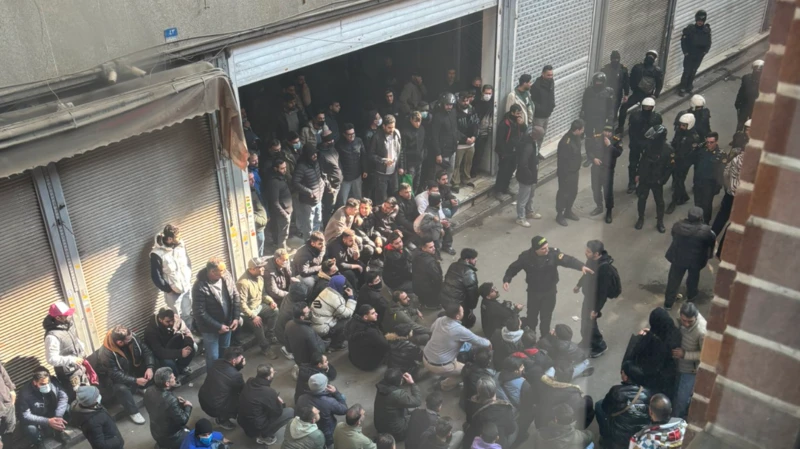
A nationwide protest movement in Iran entered its tenth day on Tuesday, marked by what observers described as the largest demonstrations yet, a widening shopkeepers' strike across multiple cities, severe confrontations in Tehran's Grand Bazaar, and mounting reports of arrests and fatalities as authorities intensified security measures—including deploying military-style vehicles and firing tear gas inside hospitals—to contain the unrest.
The strikes, which began as a response to the collapsing Rial, have now paralyzed the capital's economic heart and spread to Iran's holiest city. According to the BBC Persian Service and Iran International, the shutdowns have expanded beyond general merchandise to include the historic Gold Market (Bazaar-e Talaforoushan), as well as Tehran's Molavi market, the Delavaran furniture market, the Yaftabad market, and the Caterpillar commercial complex—a major auto parts and machinery hub in western Tehran. In Marvdasht, in southern Iran, shopkeepers also closed their shops and joined the strike in solidarity with the nationwide movement.
BBC correspondents report that security forces have fired tear gas directly into the bazaar's covered alleyways to disperse crowds chanting anti-government slogans, with additional clashes reported near the 15 Khordad metro station. Videos obtained by Iran International showed large crowds gathering at the Tehran Grand Bazaar despite a heavy armed security presence, with shopkeepers chanting "Death to the dictator" and "Death to Khamenei." Footage also showed protesters being locked inside the Mellat Mall and tear gas being fired inside the Plasco shopping center as security agents attempted to prevent demonstrations from spilling onto the streets.
Protests Spread to Mashhad and Provincial Cities
In a significant escalation, bazaar protests gained momentum in the holy city of Mashhad in northeastern Iran, where merchants chanted "No fear, we're all together." Security forces responded by firing tear gas at protesters, according to eyewitness reports. The spread of unrest to Mashhad, home to the shrine of Imam Reza and one of Iran's most religiously significant cities, adds a potent symbolic dimension to the movement.
In Yazdanshahr, in Isfahan province, protests erupted with gunfire heard as security forces deployed military-style vehicles. Eyewitnesses reported forces attacking and beating people. In videos from the city, women were heard chanting: "Free those detained in Yazdanshahr." Protesters in both Yazdanshahr and at Tehran's Baharestan metro station chanted "This is the final battle, Pahlavi will return"—pro-monarchy slogans that reflect a notable shift in protest rhetoric toward explicit calls for regime change.
Protesters also took to the streets in Abdanan, in Ilam province in western Iran, chanting "Death to Khamenei" and "This year is a year of blood, Seyed Ali [Khamenei] will be overthrown."
Second Hospital Attacked as Amnesty Condemns Violations
In one of the most alarming developments, security forces fired tear gas inside Tehran's Sina Hospital on Tuesday, according to videos sent to Iran International. Footage showed security forces closing the entrance to the hospital in the Hasanabad area, with sounds of gunfire heard nearby as protesters ran through surrounding streets chanting "Death to the dictator."
This follows an earlier incident at Imam Khomeini Hospital in Ilam, where security forces reportedly entered the facility as injured protesters were being treated. Amnesty International issued a formal condemnation on Tuesday, calling the Ilam raid a violation of international law. The rights group said forces fired tear gas, used shotguns, beat people inside the hospital, and arrested injured protesters and some family members. Amnesty urged authorities to "immediately stop the unlawful use of force" and respect medical facilities, adding that the actions showed "how far the Iranian authorities are willing to go to crush dissent."
The head of Iran's nursing organization warned that any erosion of hospital safety violates basic health-system principles. Government officials said a team had been tasked to examine what happened in Ilam.
Heavy Security and Clashes Across Tehran
Security has been heavily reinforced across Tehran, with reports of "martial law-like" conditions in central districts. A video received by Iran International showed a heavy security presence along Jomhuri Street, including the area between Lalehzar Avenue and the parliament building, with riot police moving through the area. Security forces attacked protesters near Moniriyeh Square, according to eyewitness reports.
Clashes near the Tehran bazaar area were marked by what appeared to be gunfire, according to videos showing security forces moving against protesters. Eyewitnesses describe a continued heavy presence of anti-riot police and plainclothes Basij militia on Nasser Khosrow Street and around the Parliament.
Beyond the Grand Bazaar, messages attributed to residents described clashes in Tehransar, where security forces allegedly used paintball-style launchers and tear gas. Separate accounts said people in Chaharsou Market pushed back against security forces, temporarily forcing them to retreat.
Internet access in the city of Shahrekord was reported to be severely limited on Tuesday as protests continued and security forces remained widely deployed.
Protest Slogans Shift Toward Regime Change
A notable feature of Tuesday's protests was the prominence of explicitly anti-regime and pro-monarchy slogans. Protesters at multiple locations chanted "This is the final battle, Pahlavi will return," while shopkeepers at the Yaftabad market chanted "Neither Gaza nor Lebanon, my life for Iran"—a slogan rejecting the government's regional spending priorities.
The shift from economic grievances to calls for the return of the Pahlavi dynasty reflects what analysts describe as a deep loss of faith in the Islamic Republic's electoral politics and the long-framed divide between reformists and hardliners.
Student Groups Boycott Exams
As street protests continued, university activism also broadened. Multiple student groups at University of Art campuses in Tehran and Shiraz issued statements rejecting the continuation of examinations, arguing that holding exams under current conditions amounted to an attempt to "normalize" an environment of fear and repression. Several groups said they would not participate in exams until conditions change.
Rights Groups Cite Rising Toll
Human-rights and monitoring organizations released new tallies suggesting the unrest has spread widely and that the state response is hardening.
The HRANA news agency reported protests and related incidents in at least 257 locations across 88 cities in 27 provinces over the past nine days and said the number of people detained had risen to 1,203.
Iran International said it had identified 21 people killed during the protests between Dec. 28 (7 Dey) and Jan. 5 (15 Dey), based on its own verification efforts. Separate rights reporting cited a broader figure of at least 29 deaths, including three children, during the protest period.
Iran's top Sunni cleric, Molavi Abdolhamid, issued a rare condemnation of the deadly violence against protesters, stating it was both illegal under international law and forbidden under Islamic law. "Any deadly violence against protesters is considered a crime under international law and is also religiously forbidden and unjustifiable," he wrote, offering condolences to the families of those killed.
Currency and Gold Surge to New Highs
Tuesday also brought fresh records in Iran's parallel market for foreign currency and gold, underlining the economic instability that helped spark the current wave of unrest.
Reports from Tehran's free market put the U.S. dollar above 147,000 tomans, while the "Emami" gold coin rose sharply, nearing 169–170 million tomans—a single-day jump of roughly 9–10 million tomans. The surge came despite recent changes at the central bank and government measures aimed at calming markets.
"This is no longer just about the price of gold or the dollar," one merchant told reporters on the condition of anonymity. "The bazaar is the pulse of the nation, and right now, it has stopped beating."
International Reaction Intensifies
The protests have drawn heightened international attention and diplomatic activity.
Qatar announced it was in contact with both Tehran and Washington to prevent escalation. "Qatar is in contact with Tehran and Washington to support any dialogue aimed at preventing escalation," Foreign Ministry spokesperson Majed Al Ansari said, warning that "any potential escalation regarding Iran would not only threaten the stability of the region, but would also pose a risk to the stability of the international community as a whole."
U.S. President Donald Trump posed smiling with a "Make Iran Great Again" cap after vowing on Saturday to respond forcefully if Iranian authorities killed protesters. The Persian-language account of the U.S. State Department characterized the hospital incident as a grave crime and called on Iranian authorities to release detainees after families gathered outside the governor's office in Yasuj demanding the return of their children.
German parliament vice president Omid Nouripour called for support for Iranian protesters, writing on X: "People in Iran are taking to the streets because they want to be free. We must listen and strengthen their voices. It is now or never."
Swedish Deputy Prime Minister Ebba Busch said she stood behind "the Iranian people's courageous fight for freedom," adding that Iran's Islamic system had "blood on its hands" and that the Iranian people's desire for freedom must be met with collective international support.
Iran, for its part, has publicly rejected foreign threats, with officials characterizing Washington's posture as intimidation and psychological warfare.
Tehran Tries to Frame Protests as "Riots"
Iran's Interior Ministry described demonstrators as "rioters" and claimed that the majority of protest calls originated through foreign platforms—language that signals a continued effort to portray the unrest as externally driven.
Inside prison, journalist Reza Valizadeh (described as an Iranian-American detained in Evin prison) sent an audio message condemning state broadcasting for "censorship and distortion," urging media staff to act professionally and avoid one-sided coverage.
What Comes Next
With bazaars shutting down in multiple cities including the holy city of Mashhad, student groups escalating civil disobedience, military-style vehicles deployed against protesters, and rights monitors reporting rising arrests and deaths, the protest movement appears to be entering a phase where economic disruption and institutional noncooperation could become as important as street mobilization.
The emergence of pro-monarchy slogans and explicit calls for regime change—rather than reform—signals a radicalization of demands that may make any negotiated resolution more difficult.
At the same time, the state's visible security presence in commercial centers, the use of tear gas in hospitals and crowded areas, and reports of gunfire suggest authorities are moving to prevent strikes and demonstrations from converging into sustained urban paralysis.
Much may now depend on whether:
- Strikes broaden beyond bazaars into other sectors,
- Campus boycotts spread across more universities,
- Security tactics intensify—potentially increasing casualties and international pressure, and
- International diplomatic efforts, including Qatar's mediation outreach, gain any traction.
Photo: BBC Persian