"The Bazaar Has Awakened": Historian Ervand Abrahamian on Why Iran’s Latest Protests Mark a Dangerous Turning Point
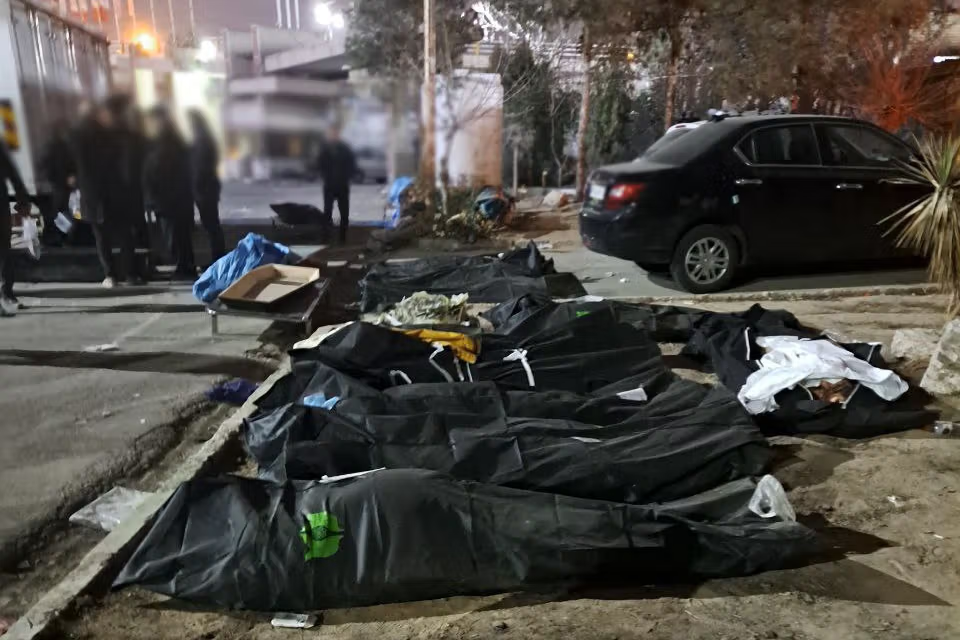
In a candid interview with journalist Farnaz Ghazizadeh, the author of Iran Between Two Revolutions argues that while the economic crisis ignited the January 2026 unrest, the true fire is fueled by the total erosion of political legitimacy.
As protests continue to grip Iran following the unrest of January 2026 (Dey 1404), renowned historian Ervand Abrahamian offers a sobering analysis of the situation. In a special interview with Farnaz Ghazizadeh from the BBC Persian Service, Abrahamian suggests that the Islamic Republic has entered a new, precarious phase of its existence—one where the historic "social contract" is broken, and the pivotal merchant class has turned against the state.
Abrahamian, celebrated for his definitive works on modern Iranian history, views the current upheaval through the lens of political economy. While acknowledging the devastating impact of sanctions and inflation, he posits that the current crisis is distinct from the movements of the past decade because of one critical factor: the return of the Bazaar.
The Return of the Market
"Protest is not new in Iran," Abrahamian noted, referencing the waves of dissent that have occurred since the 1979 revolution. However, he highlights a significant deviation in the January 2026 events.
"The difference this time is the role of the Bazaar," Abrahamian said. "This is the first time since the revolution that the market has truly taken a leading role. Since 1978, the Bazaar hasn't played such a part... In 2009, they largely stood by and watched. But this time, they are a decisive factor."
When asked by Ghazizadeh if it matters that this unrest began in the "new market"—sellers of electronics and imported goods—rather than the traditional merchants of carpets and gold, Abrahamian dismissed the distinction. "The economic crisis affects everyone, but especially those reliant on imports," he explained, noting that while the traditional Bazaar’s influence has waned due to the rise of state-linked economies like the IRGC (Revolutionary Guards), the economic pain is now universal.
A Crisis of Legitimacy, Not Just Economy
While the economic collapse provided the spark, Abrahamian argues the fuel is a profound loss of political legitimacy.
"The Islamic Republic came to power with perhaps the most popular revolution in contemporary history," Abrahamian observed. "But gradually, policy by policy, the regime has stripped away its social base. The legitimacy it once held no longer exists."
He pointed to a shift in the language of dissent as proof. "In the early days of the revolution, Islam and religion were the core of the discourse. Today, the protests speak of rights, freedom, and equality. We have returned to an era of Enlightenment values and individual rights."
The "Stalemate" and the Iron Fist
Comparing the current atmosphere to the months leading up to the 1979 revolution, Abrahamian sees striking similarities in public anger but a critical difference in the state's apparatus.
"The situation is most similar to 1978," he said. "However, the structure of the state is different. The Shah eventually realized he could not rely on the army; his regime collapsed due to a lack of legitimacy. This regime still retains a hardcore base of support, specifically the Revolutionary Guards (IRGC), who are willing to use violence in a way the Shah was not."
Abrahamian predicts a "long and painful confrontation" rather than an immediate collapse. "The regime is isolated, perhaps supported by only 10 to 15 percent of the population. But as long as the IRGC remains loyal and willing to kill, they can maintain control through force, even if the social contract is dead."
A Warning on Foreign Intervention
Addressing calls from some opposition figures for foreign assistance, Abrahamian, an expert on the 1953 coup, issued a stark warning.
"Those looking for 'American freedom' must be very careful," he cautioned. "Experience in Afghanistan, Iraq, Libya, and Syria shows that foreign intervention does not solve the problem."
Abrahamian was blunt about the geopolitical realities: "Imperialist powers are not seeking your freedom; they are seeking their own interests." He suggested that for some external actors, including elements within Israel, the goal might not be a democratic change of regime, but the fragmentation of Iran itself. "Some may believe the best scenario is for Iran to be broken into three or four small states, like Iraq, so it poses no threat."
The Nuclear Prestige
On the topic of Iran’s controversial nuclear program, which many view as a financial black hole contributing to the economic misery, Abrahamian offered a historical parallel to the nationalization of oil under Mossadegh.
"For the ruling elite, this is not an economic calculation; it is a matter of prestige and ideology," he explained. "Just as oil nationalization was about sovereignty rather than money, the nuclear program is viewed as a guarantor of status as a great power. They believe it makes them untouchable."
A Historical Moment?
When asked if these protests constitute a definitive historical turning point, Abrahamian remained cautious.
"It is undoubtedly a very important movement," he concluded. "But is it 'historic' in the sense of the French Revolution or 1979? I don't see that yet. Unless the regime offers a 'olive branch' and fundamentally changes course—which is unlikely—we are looking at a deep, unresolved crisis rather than an immediate revolution."
Photo: Iran International