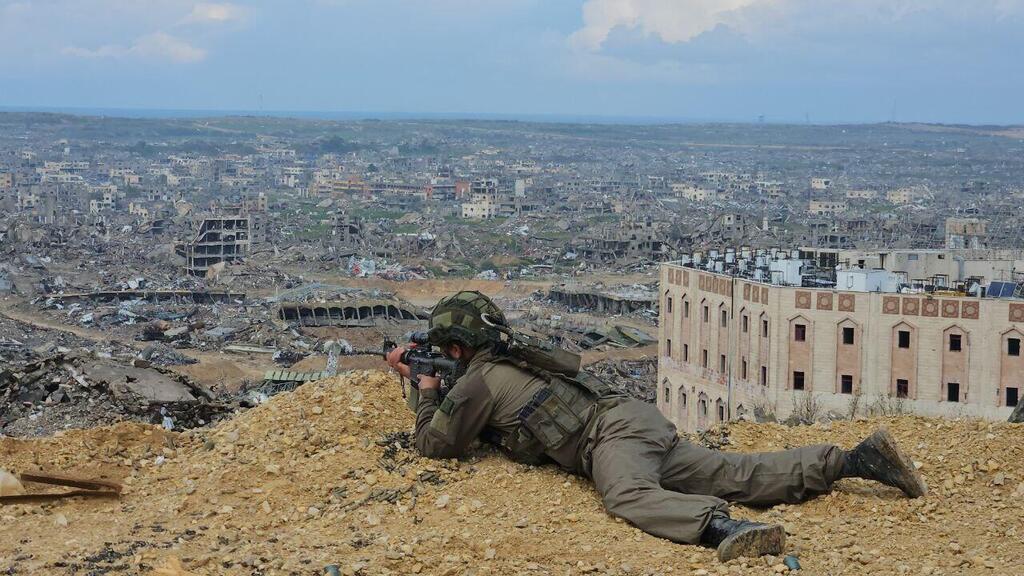
While global leaders discuss high-tech futures for Gaza in European conference halls, the view from the outskirts of Jabaliya offers a starkly different reality. Here, deep inside the Strip, the silence of the ceasefire is deceptive. Commanders on the ground report that Hamas is actively rebuilding its forces just meters away, while Israeli troops are not packing up to leave but are instead pouring concrete and fortifying positions along a new, permanent boundary known as the Yellow Line .
The disconnect between the diplomatic maneuvering of the Trump administration and the tactical reality in Beit Hanoun is profound. According to a report by Ynet, the IDF is preparing for long-term friction rather than withdrawal, investing millions in surveillance towers and heavy infrastructure to lock down the sector . While politicians envision airports, the military reality is one of "destroy and grind," where the Northern Brigade systematically demolishes remaining structures in Beit Hanoun to deny cover to militants, leaving behind a dystopian "gray carpet" of dust and ruins.
Subterranean Warfare and Strategic Depth
The operational pause has merely shifted the intensity of the conflict underground. In an aggressive move to neutralize cross-border threats, IDF engineering units recently pumped 18,000 cubic meters of concrete into shafts near Jabaliya, flooding the tunnel network until the mixture surfaced deep inside Gaza territory . Above ground, the IDF 252nd Division has established three fortified defensive belts to secure the sector. The first layer reinforces local defense platoons directly within Israeli border communities, restoring pre-war security measures. Beyond this lies a secondary security strip—the buffer zone—extending roughly one kilometer into Gaza, while the third and deepest belt follows the Yellow Line itself, bristling with tanks and high-tech observation posts .
Preparing for the Collapse
Despite the political veneer of a ceasefire, the atmosphere among the reserve officers on the ground is one of inevitable escalation. Hamas has successfully replaced its fallen commanders with younger, battle-hardened veterans and is actively plotting to bypass Israel's new defenses . Consequently, IDF forces are not training for peacekeeping or reconstruction, but for a rapid transition back to full-scale assault. The consensus among troops is that the diplomatic arrangement will eventually crumble, making the return of the "military option" a matter of time rather than possibility .The Peace Illusion: IDF Entrenches at the Yellow Line as Hamas Regroups
While global leaders discuss high-tech futures for Gaza in European conference halls, the view from the outskirts of Jabaliya offers a starkly different reality. Here, deep inside the Strip, the silence of the ceasefire is deceptive. Commanders on the ground report that Hamas is actively rebuilding its forces just meters away, while Israeli troops are not packing up to leave but are instead pouring concrete and fortifying positions along a new, permanent boundary known as the Yellow Line .
The disconnect between the diplomatic maneuvering of the Trump administration and the tactical reality in Beit Hanoun is profound. According to a report by Ynet, the IDF is preparing for long-term friction rather than withdrawal, investing millions in surveillance towers and heavy infrastructure to lock down the sector . While politicians envision airports, the military reality is one of "destroy and grind," where the Northern Brigade systematically demolishes remaining structures in Beit Hanoun to deny cover to militants, leaving behind a dystopian "gray carpet" of dust and ruins.
Subterranean Warfare and Strategic Depth
The operational pause has merely shifted the intensity of the conflict underground. In an aggressive move to neutralize cross-border threats, IDF engineering units recently pumped 18,000 cubic meters of concrete into shafts near Jabaliya, flooding the tunnel network until the mixture surfaced deep inside Gaza territory . Above ground, the IDF 252nd Division has established three fortified defensive belts to secure the sector. The first layer reinforces local defense platoons directly within Israeli border communities, restoring pre-war security measures. Beyond this lies a secondary security strip—the buffer zone—extending roughly one kilometer into Gaza, while the third and deepest belt follows the Yellow Line itself, bristling with tanks and high-tech observation posts .
Preparing for the Collapse
Despite the political veneer of a ceasefire, the atmosphere among the reserve officers on the ground is one of inevitable escalation. Hamas has successfully replaced its fallen commanders with younger, battle-hardened veterans and is actively plotting to bypass Israel's new defenses . Consequently, IDF forces are not training for peacekeeping or reconstruction, but for a rapid transition back to full-scale assault. The consensus among troops is that the diplomatic arrangement will eventually crumble, making the return of the "military option" a matter of time rather than possibility .
Photo: Ynet