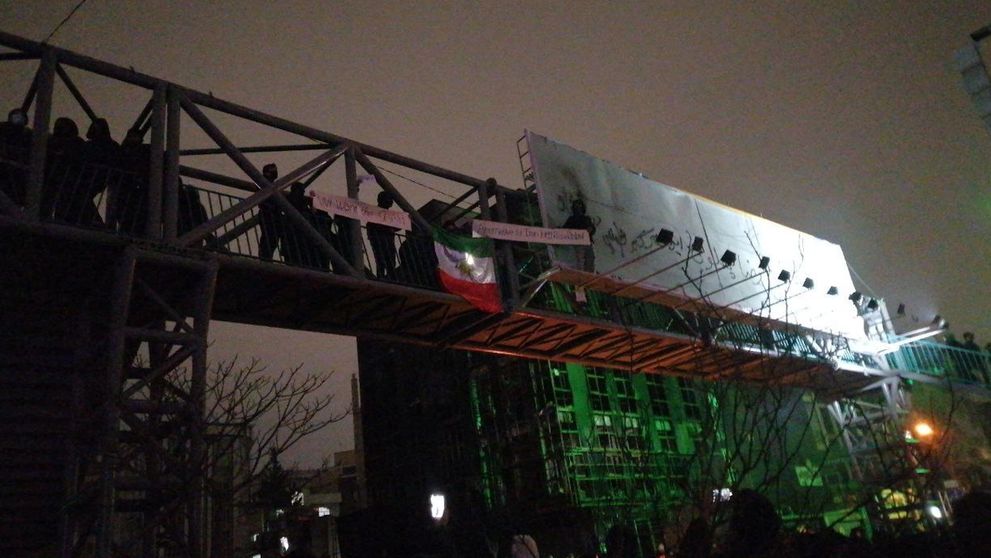
Iran's nationwide uprising has entered its third week with unprecedented defiance against the Islamic Republic's regime, even as security forces employ increasingly lethal tactics and an expansive internet blackout now stretches past 60 hours. As of Sunday, January 11, the popular revolution has spread to at least 190 cities across all 31 provinces, with death tolls rising dramatically amid what international human rights organizations describe as a potential "massacre" unfolding under the cover of censorship.
The escalating violence and regime response mark a dramatic intensification of unrest that began on December 28, initially triggered by the economic collapse of Iran's currency—the rial, which has plummeted to over 1.4 million to one US dollar. What started as street-level protests over economic desperation has evolved into an existential challenge to the clerical regime's authority, with demonstrators explicitly calling for the overthrow of Supreme Leader Ayatollah Ali Khamenei and, increasingly, expressing support for the restoration of the pre-revolutionary monarchy.
A Death Toll Spiraling Beyond Official Count
The reported death toll has surged dramatically in recent days. While earlier estimates from January 9 reported 116 deaths, with 37 being security personnel, newer reports from January 11 indicate the toll has risen to at least 192 people, according to the Norway-based Iran Human Rights organization. However, activists and international observers warn that this figure represents only confirmed deaths and may dramatically underestimate the actual toll, particularly given the severity of the communications blackout that has severely hampered information flow out of the country.
Human rights groups express grave concern about the potential for a much larger massacre occurring under the internet blackout. The Centre for Human Rights in Iran (CHRI) drew stark historical parallels, noting that "The complete Internet and communications shutdown in Iran is extremely alarming: the regime typically does this as a preface to the mass slaughter of protesters. In 2019, when protests broke out throughout the country, the Iranian authorities completely shut down the internet—and then proceeded to kill over 1000 protesters." Hospitals in Tehran and Shiraz have reported being overwhelmed with injured protesters, many bearing military-grade gunshot wounds to the head and neck—wounds indicating security forces are aiming to kill rather than disperse.
The Internet Blackout's Purpose
Perhaps most alarming is the communications blackout, which has now persisted for over 60 hours with overall connectivity hovering at just 1% of normal levels, according to internet monitoring group NetBlocks. While regime leadership continues to post propaganda on state media, 90 million Iranians have been cut off from coordinating resistance efforts or documenting atrocities. This censorship represents what NetBlocks characterizes as a "digital kill-switch" designed to both hide the extent of the security crackdown from international observers and prevent protesters from organizing coordinated action.
The regime's strategy extends beyond internet censorship. In the early hours of January 11, Tehran municipality workers were reportedly tasked with clearing spent bullet casings from streets—physical evidence of the lethal force being deployed.
Expansion and Organization Despite Repression
Despite the violence and communications cutoff, the uprising continues to expand and demonstrate signs of organization that confound earlier assumptions the movement was entirely leaderless. On January 10, demonstrators gathered in Tehran's Heravi Square and multiple neighborhoods including Shahrara, Shahrak-e Gharb, Punak, Saadat Abad, and Pol-e Rumi, chanting "Death to the dictator" with crowds described as so large that participants could not see the beginning or end of the gatherings.
Beyond the capital, protests continue in Mashhad (Iran's second-largest city), Tabriz, Rasht, Karaj, Isfahan, Shiraz, and dozens of other urban centers. In Mashhad, rebellious youth attacked police stations and destroyed surveillance cameras critical to regime identification and arrest efforts. In Izeh, Khuzestan province, what observers described as a "full-scale battle" erupted when protesters seized the local Red Crescent building—which the regime had repurposed as a suppression equipment depot—and set it ablaze along with regime vehicles.
International Dimensions and Military Threats
The uprising has drawn unprecedented international attention and raised the specter of military intervention. US President Donald Trump has repeatedly expressed support for the protesters, stating that "the USA stands ready to help" and warning of a potential military strike on Iran. Trump was reportedly presented with military options for such a strike on Saturday evening, though he has not yet made a final decision.
Iran has responded with bellicose warnings. Parliamentary Speaker Mohammad Baqer Qalibaf declared on Sunday that "In the event of a military attack by the United States, both the occupied territory [Israel] and centres of the US military and shipping will be our legitimate targets." This escalation reflects regime anxiety about potential external intervention even as it confronts an unprecedented internal rebellion.
The Arrests and Regime's Desperate Measures
The regime's repression extends beyond violence to sweeping arrests. Police Chief Ahmad-Reza Radan announced on Sunday that "significant arrests were made of the main elements in the riots," though he provided no specifics. At least 2,600 people have been detained since protests began, according to the US-based Human Rights Activists News Agency.
Desperate to maintain control, Iranian courts have been instructed to issue indictments "without wasting time" and show "no mercy" to those arrested, with prosecutors explicitly threatening charges of "Moharebeh" (waging war against God)—a capital offense in Iran. Meanwhile, the regime has also claimed that a Mossad agent was among the arrested protesters, attempting to frame the uprising as a foreign conspiracy.
A Movement Defining Its Vision
Notably, as the uprising continues, its demands have crystallized beyond economic grievances. While some demonstrators explicitly support Crown Prince Reza Pahlavi and the return of the pre-revolutionary monarchy—with the historic lion and sun flag briefly replacing the Iranian flag at Iran's embassy in London—others insist on forward-looking demands for democratic self-determination and popular sovereignty.
This distinction was captured in widespread chants that have become the uprising's signature slogan: "Death to the oppressor, be it the Shah or the Leader [Khamenei]." This formulation signals that Iranians seek neither the return of autocracy nor the continuation of theocratic dictatorship—they are demanding genuine democratic governance and popular sovereignty.
As the uprising enters its fifteenth day with millions mobilized across the nation despite lethal force, internet cutoffs, and mass arrests, the Iranian regime faces its most existential challenge since the 1979 revolution. The question now is whether international pressure can constrain the violence, whether the blackout will ultimately fail to suppress the rebellion, and whether this uprising will prove to be the moment the Islamic Republic's authoritarian hold finally fractures.
Photo: Iran International