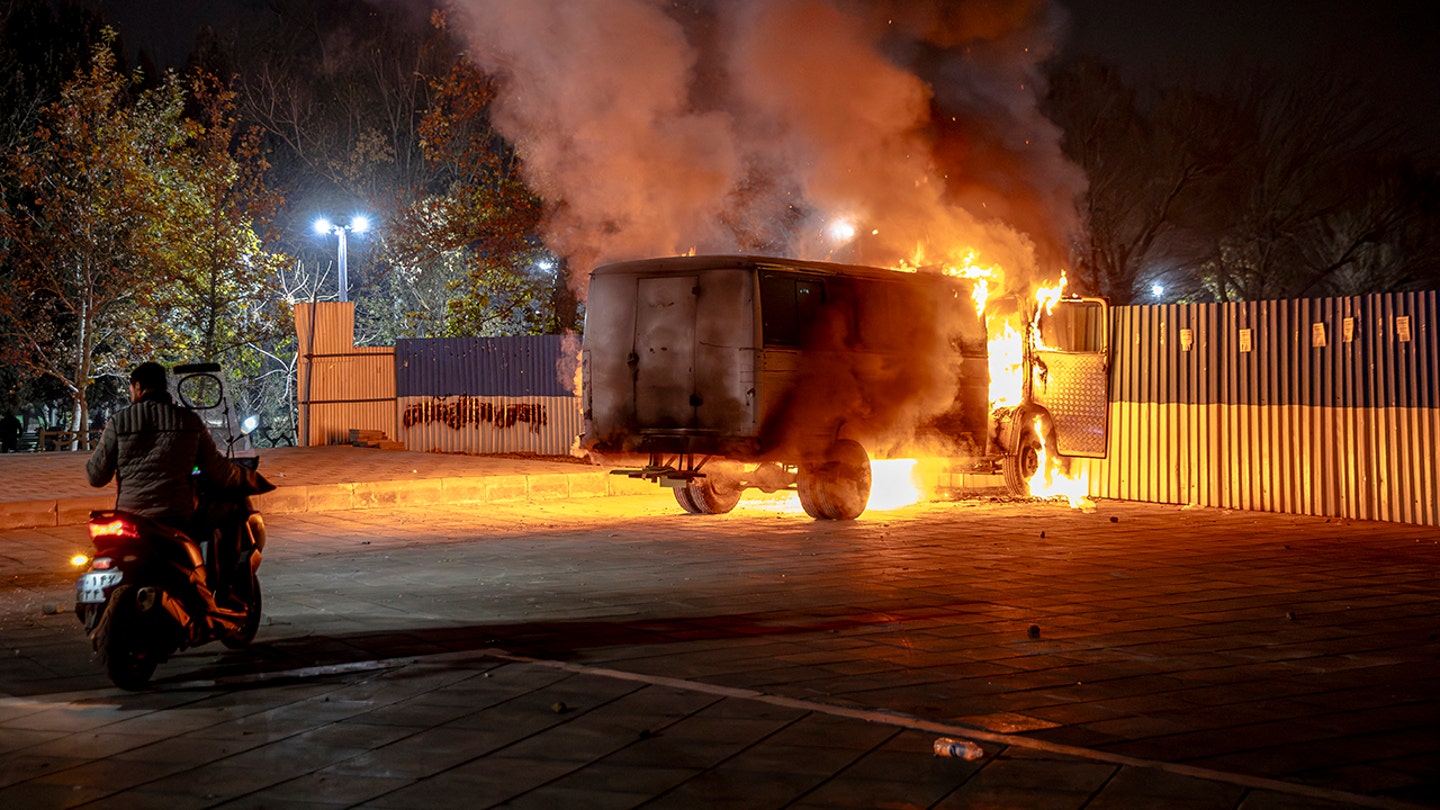
"Iran's in big trouble," President Trump said at a press conference Friday. "It looks to me that the people are taking over certain cities that nobody thought were really possible just a few weeks ago. We're watching the situation very carefully."
The president's comments came after he issued a stern warning on Truth Social earlier in the week, declaring that the U.S. is "locked and loaded and ready to go" if the Iranian regime "shoots and violently kills peaceful protesters."
"We'll be hitting them very hard where it hurts. And that doesn't mean boots on the ground, but it means hitting them very, very hard where it hurts," Trump added.
Death Toll Climbs as Hospitals Overwhelmed
The death toll from the ongoing protests has risen to at least 72, with more than 2,300 people detained, according to the U.S.-based Human Rights Activists News Agency. Iranian hospitals have been overwhelmed with injuries, with medical staff reporting a surge of patients suffering from gunshot wounds to the head and eyes.
A doctor from Tehran's Farabi Hospital told the BBC that the facility entered crisis mode, with emergency services slammed and non-urgent admissions suspended. The protests, which began late last month over accelerating inflation and the collapse of the Iranian rial, have spread from bazaars and markets to universities and provincial cities across the country.
Regime at 'Weakest Point' in 45 Years
Fox News senior strategic analyst Gen. Jack Keane (Ret.) offered a grave assessment of the Iranian regime's position during an appearance on "Special Report."
"If I was in the Iranian regime, I would take President Trump dead serious here," Keane warned. "This is the weakest the Islamic Republic of Iran has been in 45 years, with no prospect of recovering."
Keane pointed to multiple factors contributing to the regime's vulnerability: "Politically, they can't meet the social and political and economic aspirations of the people. Economically, they're in the tank. And militarily, they just lost a war. They've lost their platform in Syria. Their proxies are, by and large, decapitated and almost eliminated."
The retired general appeared to reference the U.S. military's destruction of Iran's nuclear enrichment sites in 2025, adding, "Anybody at this point that doesn't take President Trump serious when he's saying something like this, given the last year, is certainly reckless and irresponsible."
Exiled Prince Appeals to Trump
Exiled Iranian Crown Prince Reza Pahlavi issued an urgent appeal to President Trump as the regime implemented a nationwide internet blackout to suppress protest coordination.
"Mr. President, this is an urgent and immediate call for your attention, support, and action," Pahlavi wrote on X. "Last night you saw the millions of brave Iranians in the streets facing down live bullets. Today, they are facing not just bullets but a total communications blackout."
Pahlavi credited Trump's earlier warning with restraining the regime's violence, saying the threat "kept the regime's thugs at bay" during Thursday night's protests. He described the movement as "unprecedented," noting that over 100 cities have seen demonstrations with millions of people chanting "Death to the dictator."
"The regime is crumbling and is very close to collapsing," Pahlavi told Fox News' Sean Hannity.
Regime Escalates Threats
Despite U.S. warnings, Iranian Supreme Leader Ayatollah Ali Khamenei has signaled a coming crackdown. Tehran escalated its threats Saturday, with Iran's attorney general, Mohammad Movahedi Azad, warning that anyone taking part in protests will be considered an "enemy of God" — a charge that carries the death penalty.
"Prosecutors must carefully and without delay, by issuing indictments, prepare the grounds for the trial and decisive confrontation with those who, by betraying the nation and creating insecurity, seek foreign domination over the country," the statement read. "Proceedings must be conducted without leniency, compassion or indulgence."
Khamenei also took a swipe at Trump, claiming that protesters were "ruining their own streets" to please the American president.
Administration Shows United Front
Secretary of State Marco Rubio expressed solidarity with the Iranian people on Saturday.
"The United States supports the brave people of Iran," Rubio wrote on X.
The administration's firm stance comes as experts debate what could follow if the Islamic Republic were to fall. Analysts say the critical question is whether Iran's security forces — including the Islamic Revolutionary Guard Corps and Basij militia — will fracture or hold.
Behnam Ben Taleblu, a senior fellow at the Foundation for Defense of Democracies, told Fox News Digital that the key factor is "whether segments of the security forces defect, refuse orders, or fragment."
"What has to be chipped away is the regime's coercive power," Ben Taleblu said, warning against Western governments settling for a "cosmetic transition that merely reshuffles elites."
Looking Ahead
As protests continue to spread and the regime faces mounting internal and external pressure, the Trump administration has made clear it will not stand idly by if the Iranian government escalates violence against its own citizens.
When asked about the probability of U.S. or Israeli action in support of protesters, Gen. Keane declined to offer specifics but reiterated his warning: "I think I would take the president serious. I have no insight into what they're thinking, but I'm listening to what they are saying. And he's dead serious."
Photo: Fox News