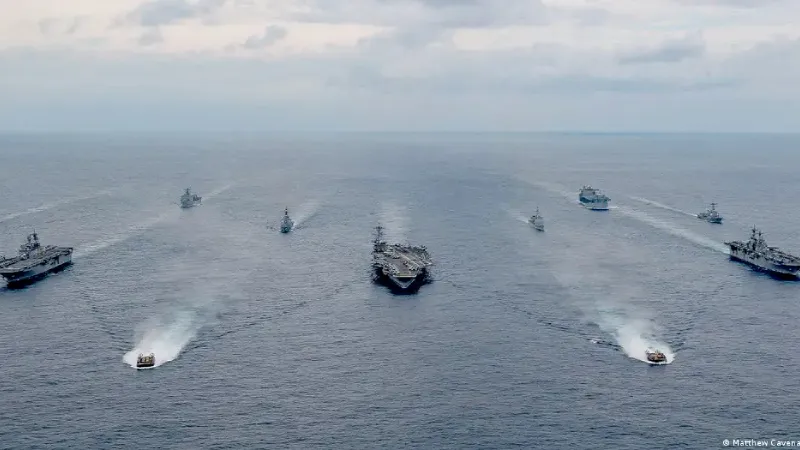
Tensions between Washington and Tehran escalate dramatically with Trump deploying carrier strike group amid ongoing crackdown on domestic protests.
In a significant escalation of military posturing, President Donald Trump announced that a substantial U.S. naval flotilla is heading toward Iran, describing it as an "armada" while speaking from the World Economic Forum in Davos, Switzerland. The deployment underscores intensifying tensions between Washington and Tehran as the Trump administration applies military pressure alongside diplomatic maneuvering amid a severe Iranian security crackdown on nationwide protests.
The announced naval contingent includes the USS Abraham Lincoln aircraft carrier strike group, currently positioned in the Indian Ocean after redeployment from the South China Sea, along with three guided-missile destroyers equipped with Tomahawk cruise missiles. The carrier group represents a substantial increase in American strike capability in the region, providing sustained airpower independent of regional land bases and enabling high-sortie generation rates for extended operations.
Trump's military posturing follows weeks of deteriorating conditions inside Iran, where anti-government demonstrations that began in late December have spiraled into the country's most serious internal crisis in recent years. According to human rights organizations, the death toll from the security crackdown has reached at least 5,002, with activists warning that many more fatalities may have occurred. The Iranian government has implemented an unprecedented internet blackout lasting over two weeks, severely restricting information flows from the country.
Iran's response to American military threats has been characteristically defiant. Foreign Minister Abbas Araghchi stated in an opinion piece published in The Wall Street Journal on Tuesday that "our formidable military forces have no hesitation about retaliating with all our capabilities if we are attacked again." Iranian military commanders have escalated the rhetoric further, with General Olfaz Sheki warning that Trump "knows that if an act of aggression is made toward our leader, we will not only cut off that hand... we will ignite their world and leave them without refuge in the region."
The current crisis represents a continuation of escalating hostilities dating back to June 2025, when the United States and Israel conducted devastating airstrikes on Iranian nuclear facilities. At that time, the U.S. deployed 125 aircraft to strike three Iranian nuclear sites, and Iran responded with a largely symbolic missile attack on an American base in Qatar. Trump subsequently announced a unilateral ceasefire, which Iran claimed was a diplomatic victory.
Senior Trump administration officials are reportedly evaluating both diplomatic and military options. Vice President JD Vance and Secretary of State Marco Rubio are presenting a range of strategies to the president, "from diplomatic measures to military actions," according to the White House. Simultaneously, Trump has threatened nations conducting business with Iran with a 25 percent tariff on U.S. trade, signaling an economic pressure campaign alongside military threats.
The Trump administration has also ordered U.S. personnel evacuations from Iran, with the Virtual Embassy in Tehran advising American citizens to leave immediately through Turkey or Armenia. Pentagon officials have begun withdrawing some military personnel from Middle Eastern bases as a precautionary measure against potential Iranian retaliation.
While Trump suggested on Thursday that he would "rather not see anything happen," the deployment of additional naval assets and continued military threats indicate the administration is maintaining maximum pressure on Tehran. The situation remains volatile, with both sides engaged in what analysts describe as strategic brinkmanship designed to demonstrate resolve while preserving diplomatic off-ramps.
Photo: T24