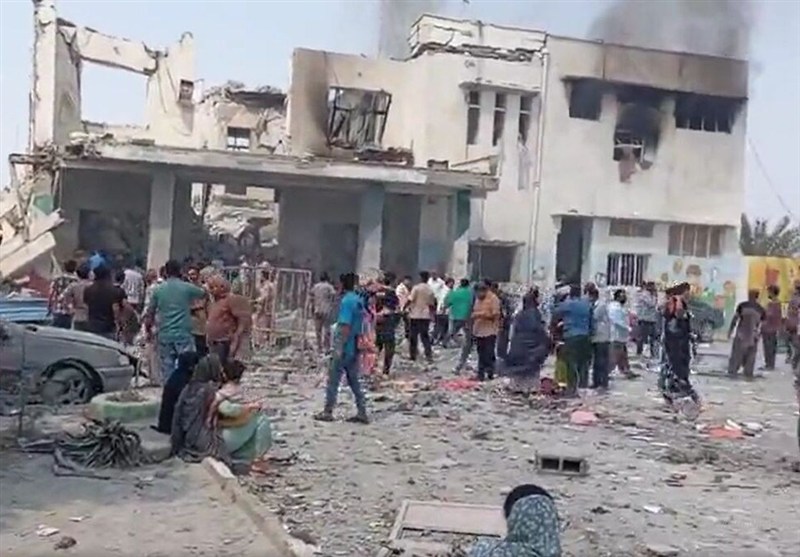
Iran to Honor Student Martyrs by Converting US-Destroyed School into Museum

Iran's Minister of Education Ali-Reza Kazemi proposed converting the Minab elementary school that was devastated during the current US-Israel aggression into a museum honoring the student martyrs. According to the Tasnim News Agency, Kazemi outlined the plan during a webinar with provincial education officials and school renovation authorities. The minister specifically highlighted the girls’ elementary school in Minab as a site for preserving the memory of those who lost their lives.

Furthermore, Kazemi stated that a new school, named Shajareh Tayyebeh, should be constructed with a unique design symbolizing knowledge, sacrifice, and remembrance of the student martyrs.

The minister addressed multiple attacks on schools nationwide, asserting that targeting educational institutions demonstrates the enemy’s desperation. He emphasized the need to leverage media, cultural initiatives, and international cooperation to condemn these acts.

"Targeting educational institutions reflects the weakness and desperation of the enemy and should be highlighted through media, cultural, and international efforts," Kazemi stated.

Kazemi urged education authorities to collaborate with international organizations to denounce the attacks, suggesting avenues such as public petitions and documentary filmmaking to amplify global awareness.

He directed provincial officials to furnish comprehensive reports detailing the damage sustained by schools, classifying them based on the necessity of repairs, reinforcement, or complete reconstruction. He stressed the importance of projecting estimated funding to ensure swift commencement of rebuilding efforts following the conflict's conclusion.

Preliminary assessments suggest that a number of schools suffered complete destruction under US-Israeli fire, while a greater number endured minor damage amenable to repair.

Looking ahead, the minister reaffirmed the commitment to maintaining uninterrupted educational progress and school construction endeavors despite the ongoing enemy aggression.

Photo: Tasnim

More News

Iran’s Leaderless War Machine: The IRGC’s Autonomous Cells and the Escalation Nobody Controls

In the fog of a war that has already claimed Iran’s supreme leader and its top military brass, a new and perhaps more dangerous threat is emerging from the rubble of Tehran’s shattered command structure: a Revolutionary Guard Corps that, by design, no longer needs orders from above. Sources with direct knowledge of the situation confirm that Iran’s Islamic Revolutionary Guard Corps (IRGC) continues to prosecute strikes across the region not under the direction of the new Supreme Leader Mojtaba Khamenei, but according to pre-programmed autonomous protocols embedded deep within its decentralized “mosaic defense” architecture. The result is a war machine that has become, in the most literal sense, self-propelling — and increasingly difficult for anyone to stop. A New Supreme Leader With Limited Command Mojtaba Khamenei was formally elected Supreme Leader on 8 March 2026, succeeding his father Ayatollah Ali Khamenei, who was killed in the opening wave of the US-Israeli “Operation Epic Fury...

2026 US/Israel–Iran War Risk: Why the Chance of Escalation Is Meaningfully Elevated

As 2025 closes, the US/Israel–Iran confrontation is no longer a low-grade shadow struggle managed mainly through diplomacy and proxy conflicts ; it is an openly articulated deterrence contest in which leaders have publicly tied credibility to “red lines” and rapid retaliation. President Trump has stated that if Iran rebuilds its nuclear capabilities or continues rebuilding missile capacity , the response could be immediate and more severe—language that reduces room for quiet de-escalation once a new incident occurs.  At the same time, Iran has replied with warnings of harsh consequences for any renewed attacks, reinforcing a mutual-threat environment where misperception and political signaling can substitute for verifiable facts.  Against that backdrop, the key analytical point for 2026 is not whether a “full war” is the default outcome; it is that the probability that a limited clash escalates into a broader, sustained conflict is meaningfully elevated because the stabili...

Iran's Headscarf Rules Quietly Loosen — But No Law Has Changed

Bareheaded women appear openly in Tehran cafés and streets, yet activists warn the shift is fragile and the law remains on the books. Images have been circulating on social media of something that would have been almost unimaginable in Iran just a few years ago: women sipping coffee in Tehran cafés, strolling busy city streets, and sitting in restaurants — all without a headscarf. The scenes have ignited global attention and renewed debate over whether the Islamic Republic is quietly retreating from one of its most defining ideological pillars. For decades, wearing the hijab in public has been mandatory for all women in Iran — a rule enshrined in the Islamic Penal Code since 1983 and treated as a cornerstone of the clerical state established after the 1979 revolution. Violations could result in fines, arrest, or worse. Yet in recent weeks and months, enforcement appears to have noticeably slackened, at least in major urban centres. A Visible Shift on the Streets Reporters and residents...