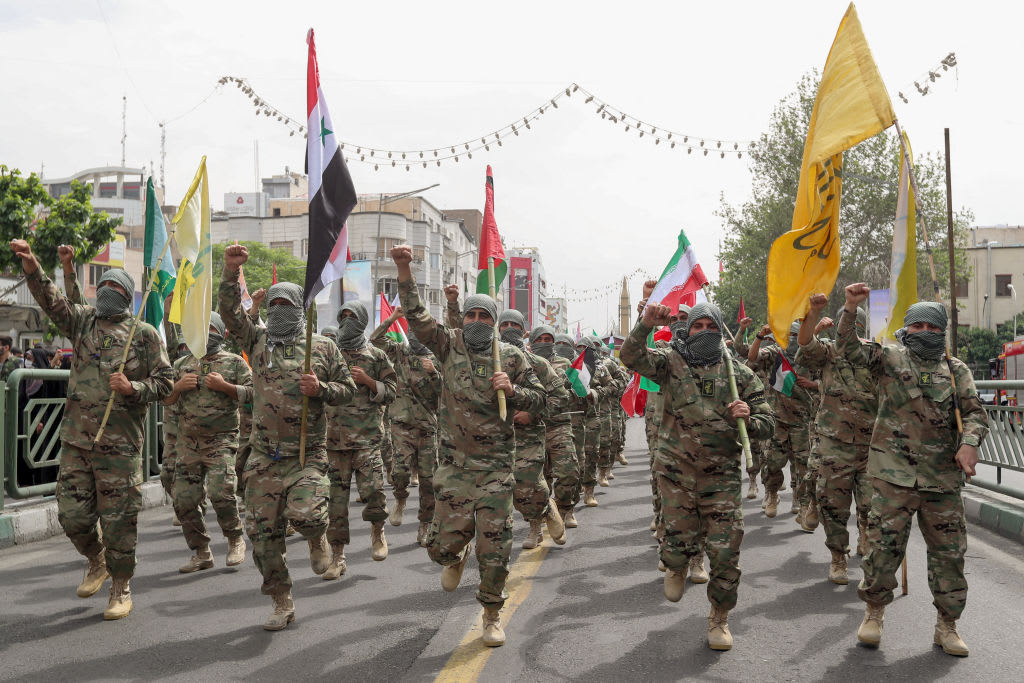
Israel has announced the killing of Gen. Gholam Reza Soleimani, the commander of Iran’s powerful Basij paramilitary force, in what it describes as a precision airstrike in the heart of Tehran, further escalating a rapidly widening regional war that has already claimed senior figures at the top of the Islamic Republic’s security establishment.
In a statement issued on Tuesday, the Israeli military said its air force carried out a “precise strike” on Monday night that eliminated Soleimani, the head of the Islamic Revolutionary Guard Corps’ all‑volunteer Basij force.
According to the statement, the strike was guided by “accurate intelligence” from Israel’s military intelligence directorate and was conducted “in the heart of Tehran,” underscoring Israel’s willingness and ability to hit high‑value targets far inside Iranian territory.
The military accused the Basij under Soleimani’s command of leading systematic crackdowns on domestic dissent, particularly during waves of anti‑government protests in recent years.
“During internal protests in Iran, particularly in recent periods as demonstrations intensified, Basij forces under Soleimani’s command led the main repression operations, employing severe violence, widespread arrests, and the use of force against civilian demonstrators,” the statement said.
Iran has not yet officially confirmed Soleimani’s death, and state media have so far remained silent or limited themselves to reporting continued Israeli strikes, raising questions over how and when Tehran will acknowledge the loss of one of the key pillars of its internal security machinery.
A Key Pillar Of Iran’s Internal Repression
Gholam Reza Soleimani, born in 1965 according to U.S. Treasury sanctions documents, has long been a central figure in Iran’s domestic security architecture.
As head of the Basij, a vast volunteer militia network attached to the Revolutionary Guard, he commanded forces deeply embedded in schools, universities, workplaces and neighborhoods across the country.
Western governments have sanctioned him for years over human rights abuses, accusing the Basij of using live ammunition and lethal force to suppress protests, including the November 2019 demonstrations that left hundreds of Iranians dead.
The European Union has held him personally responsible for “violent suppression” and “serious human rights violations” tied to those crackdowns.
Analysts say removing the Basij chief in the midst of an acute security crisis could strain command and control inside Iran at precisely the moment the leadership relies most on the force to deter or crush any domestic uprising.
Since the war began, Israel has made no secret of its focus on decapitating Iran’s leadership, arguing that dismantling the core security elite will hasten the erosion of the Islamic Republic’s grip on power.
Part Of A Broader Campaign Against Iran’s Leadership
The killing of Soleimani is the latest in a series of high‑profile strikes targeting Iran’s top officials since the conflict erupted on 28 February.
Israel’s defense minister, Israel Katz, has said the military also killed Ali Larijani, a top security official and former parliament speaker, in an overnight strike, describing it as the most significant assassination since the operation that killed Supreme Leader Ayatollah Ali Khamenei earlier in the war.
“Larijani and the Basij commander were eliminated last night and have joined Khamenei … in the depths of hell,” Katz declared in a statement quoted by international media, framing the campaign as a systematic effort to dismantle what Israel calls the “axis of evil.”
Iran has yet to confirm Larijani’s death, though a handwritten note of condolence for Iranian sailors killed in a U.S. strike was posted to his account and amplified by state media, raising questions about when it was written and whether he personally authored it.
These killings come on top of earlier strikes that Israel claims eliminated Khamenei and several senior military commanders, part of what officials in Jerusalem describe as a strategy of “focused targeting” of the regime’s decision‑making core.
Foreign Minister statements cited in regional media go further, arguing that the Iranian system “cannot be toppled except by Iranians themselves,” and openly calling on a future supreme leader to appear as the crisis deepens and the leadership vacuum becomes more pronounced.
Tehran Under Fire, Gulf States Condemn Iranian Fire
The assault that killed the Basij commander was one of several recent Israeli strikes on the Iranian capital, as Israeli aircraft and missiles pound command centers, air defense sites and Revolutionary Guard facilities amid a broader air campaign.
At the same time, Israeli jets have repeatedly hit targets in Lebanon, including Beirut’s southern suburbs and positions in southern Lebanon, in an effort to degrade allied Iranian‑backed forces such as Hezbollah.
Iran has responded with a barrage of missiles and drones aimed at Israel, U.S. bases and, increasingly, regional states seen as part of the U.S.–Israeli camp.
The cross‑border exchanges have rattled global energy markets and raised fears of a wider regional conflagration centered on the Strait of Hormuz, the narrow waterway through which a large share of the world’s oil flows.
Senior Iranian officials, including Deputy Foreign Minister Abbas Araghchi, have warned the United Nations that the security of the strait “cannot be separated” from an end to U.S. and Israeli attacks, insisting that Hormuz is effectively “closed to enemies” and that further escalation will bring more drastic measures.
Iranian insiders quoted by international news agencies say Mojtaba Khamenei, the late supreme leader’s influential son, is pushing for a harder line against the U.S. and Israel even as rumors swirl about his own whereabouts and health—claims Iran’s ambassador in Moscow has publicly denied.
Gulf states, in particular the United Arab Emirates, now find themselves directly in the line of fire as Iran widens its target set to include U.S. partners in the region.
The UAE has reported intercepting waves of Iranian missiles and drones in recent days, though debris from one interception killed at least one Pakistani national and injured others, underlining the risks to civilians even when defenses succeed.
In a statement delivered before the UN Human Rights Council in Geneva, the UAE categorically rejected Iranian claims that its attacks are “retaliatory,” calling them “unprovoked and unlawful aggression” against the Emirates and neighboring states.
The UAE said Tehran’s justifications are “attempts to mislead the international community” and stressed that targeting civilians and civilian infrastructure “constitutes a grave violation of international humanitarian law and international human rights law.”
Abu Dhabi pointed to a UN Security Council resolution, co‑sponsored by 136 member states, which condemns the Iranian strikes and demands that Tehran halt its attacks and threats against neighbors, whether directly or through regional proxies.
Emirati officials say the attacks have killed seven people and wounded 142, warning that ongoing strikes threaten regional stability, international shipping and global supply chains tied to Gulf energy exports.
Photo: Time