Bahçeli Tells Kılıçdaroğlu: “Reach an Agreement with Özel, Do Not Take the Helm”—What Is Happening?*
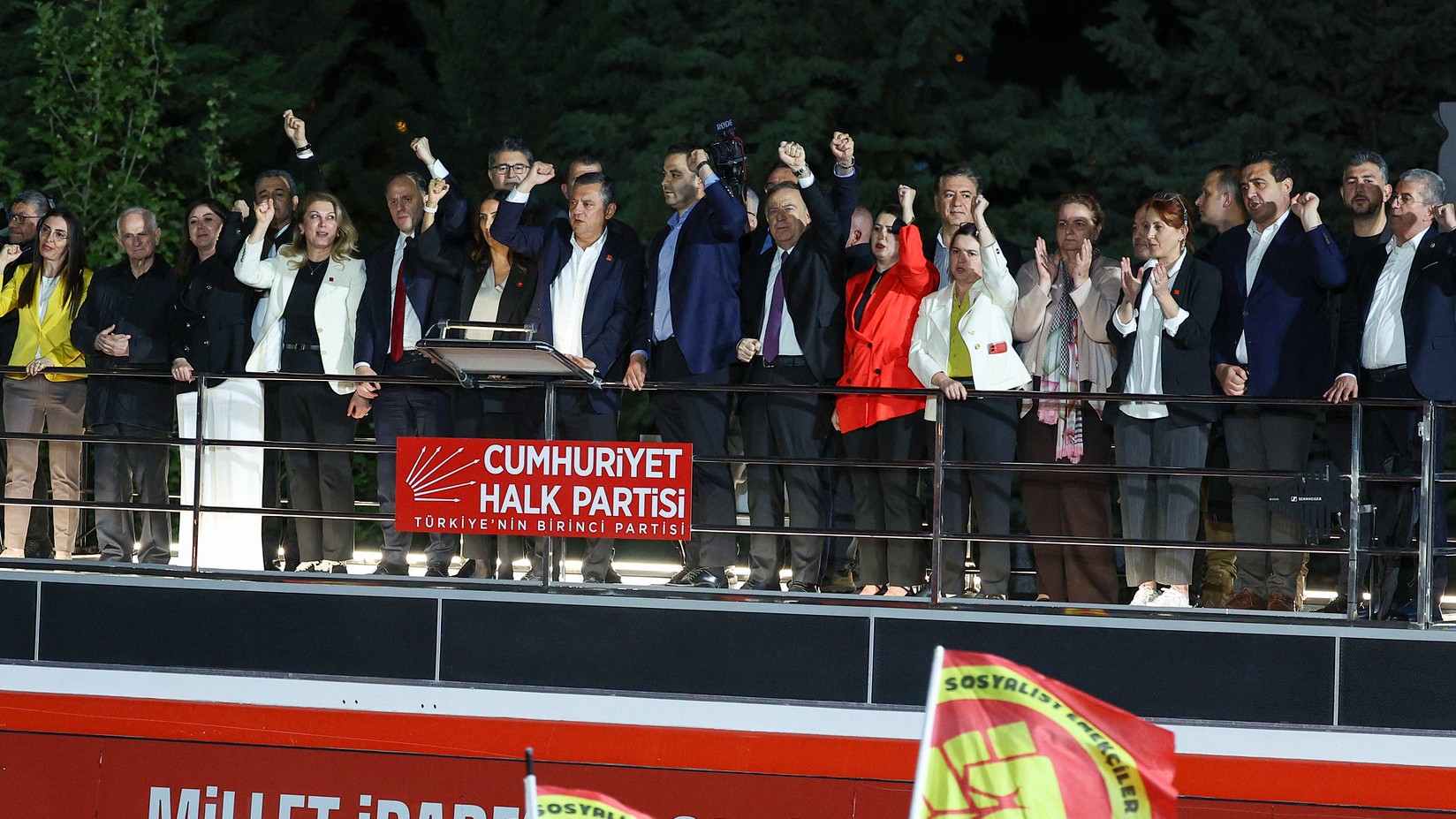
As CHP leader Özgür Özel mounts a resistance against the absolute nullity ruling, MHP leader Devlet Bahçeli's statements point to a covert game plan. (Above) Özel and the CHP leadership address protesters gathered in front of party headquarters on the night of May 21. Former CHP heavyweight Önder Sav is visible on the far left. (Photo: CHP)
The most intriguing political reaction to the Court of Appeals' unprecedented decision—which ousted Özgür Özel’s democratically elected CHP leadership and reinstated Kemal Kılıçdaroğlu—came from MHP leader Devlet Bahçeli. While Bahçeli did not use those exact words, perhaps sensing that the situation was about to spiral completely out of control, he was essentially telling Kılıçdaroğlu: "Reach an agreement with Özel; do not take the helm again." This becomes clear when examining the backroom game plans currently circulating in political corridors.
The MHP leader is seeking to position himself as the architect of a "reconstructed" Turkish political landscape—not only through the "Terror-Free Turkey" initiative but also by navigating the CHP’s judicial-political deadlock.
We will unpack this shortly, but first, we must examine what the Court of Appeals’ May 21 ruling actually entails.
The spectacle of a court ousting the leader of Turkey's main opposition party—who was elected at a party congress nearly three years ago—and replacing him with his predecessor will have traumatic repercussions on the country's already backsliding democratic credentials and its crisis-ridden economy.
Why Was the Nullity Ruling Issued on Thursday?
Kılıçdaroğlu's video release on May 20 had already been interpreted behind the scenes as a clear harbinger that the Appeals Court would issue an absolute nullity ruling.
With the upcoming Eid al-Adha holiday extended to nine days, speculation grew that any protests organized by the CHP during the break would remain muted. There were even predictions that while the decision was already drafted, its announcement would be delayed until the evening of Friday, May 22—after the Borsa Istanbul closed—to cushion the economic shock. Others speculated it might be held off until Tuesday, May 26, leaving the CHP virtually no time to file an appeal.
Both the Kılıçdaroğlu and Özel camps were well aware of these scenarios.
However, once word leaked that the ruling would be dropped as a fait accompli on Thursday, May 21, senior figures within the ruling Justice and Development Party (AKP) reportedly reached out to President Recep Tayyip Erdoğan to block it, but to no avail. Ultimately, Justice Minister Akın Gürlek's agenda prevailed. Notably, apart from Gürlek himself, no AKP official has openly defended the decision, let alone claimed it "strengthened democracy" or tried to dissuade the CHP from resisting.
Resistance from Özel, a Proposal from Bahçeli
As expected, CHP leader Özel dug in at party headquarters, choosing resistance over compliance.
Özel’s declaration during his speech—"We reject the cozy, comfortable, and perpetual seats of opposition offered to us"—is highly significant and carries a double meaning.
The overt meaning is a flat-out refusal to act as "His Majesty’s loyal opposition."
The covert meaning, however, points to the backchannel diplomacy quietly playing out between Kılıçdaroğlu and Özel over the last few days.
That MHP leader Bahçeli was well aware of this backchannel traffic is clear from the proposal he floated through journalist Hande Fırat on CNN Türk on the night of May 21.
After offering Kılıçdaroğlu the consolation that the injustice done to him had finally been recognized, Bahçeli issued the following call:
"He should meet with Özel and declare that he is stepping aside in order to establish a joint formula for the future of the CHP. This outcome would benefit both the CHP and our country."
In the same statement, Bahçeli pointedly noted that he had been proven right in his earlier warning against meddling in the CHP's internal affairs (the target of which is now clearly understood to have been Justice Minister Gürlek). By doing so, Bahçeli is actively encouraging Kılıçdaroğlu to "waive" his court-mandated return to the party helm and instead broker a compromise with Özel.
The Underlying Game Plan
Bahçeli is essentially proposing a formula in which neither Kılıçdaroğlu nor Özel runs for the leadership.
Recall that in the past, Bahçeli stated that if his university classmate (Kılıçdaroğlu) were not leading the CHP, he would prefer Özel over Istanbul Mayor Ekrem İmamoğlu. Now, he wants both men to step aside in favor of a consensus candidate.
To be frank, I was left dumbfounded when I heard Bahçeli’s proposal.
I had heard murmurs of such a game plan from a source just half an hour earlier, but I certainly did not expect Bahçeli to be the one to pitch it publicly.
The blueprint shared with me—which, frankly, I find highly risky—looks like this:
In exchange for Özel agreeing to vacate the CHP leadership, Kılıçdaroğlu would persuade the plaintiffs in the nullity lawsuit to withdraw their complaints, effectively killing the case.
Kılıçdaroğlu would then convene an extraordinary congress at the earliest opportunity, where a consensus third candidate agreed upon by both men would run for the leadership.
Bahçeli simply skipped the finer details, but he was proposing the exact same path. This aligns perfectly with rumors circulating in the corridors that the CHP camp told Kılıçdaroğlu, "You select the delegates and let’s head to a congress," as well as Ankara Mayor Mansur Yavaş’s recent call on Kılıçdaroğlu to convene an extraordinary congress immediately.
Naturally, this plan would effectively vaporize Ekrem İmamoğlu’s prospects—both for the presidential nomination and the party leadership. Then again, if the Court of Cassation upholds the nullity ruling, the Özel administration’s prior decision to designate İmamoğlu as the presidential candidate becomes legally null and void anyway.
This Matter is Far From Over
First and foremost, Bahçeli seems to have realized that things are not going exactly as either Gürlek or Kılıçdaroğlu had envisioned.
It is also evident he is trying to prevent these emerging fault lines in domestic politics from throwing a wrench in the works—especially when he had only recently convinced President Erdoğan to update his "Terror-Free Turkey" roadmap based on Bahçeli's own initiative.
The tactical maneuvering to bury the nullity ruling under the cover of a nine-day holiday has clearly failed to produce the desired silence.
The CHP leadership will not back down.
Furthermore, this judicial intervention seriously threatens to sabotage Erdoğan’s efforts to revive relations with the EU and wider Europe, right on the eve of a critical NATO Summit.
Ultimately, this is not an issue that can be swept under the rug with swift faits accomplis. This saga has plenty of mileage left in it.
* First published in YetkinReport on May 22, 2026
** The views and arguments presented in this article do not necessarily reflect the official editorial stance of The Levant Files.