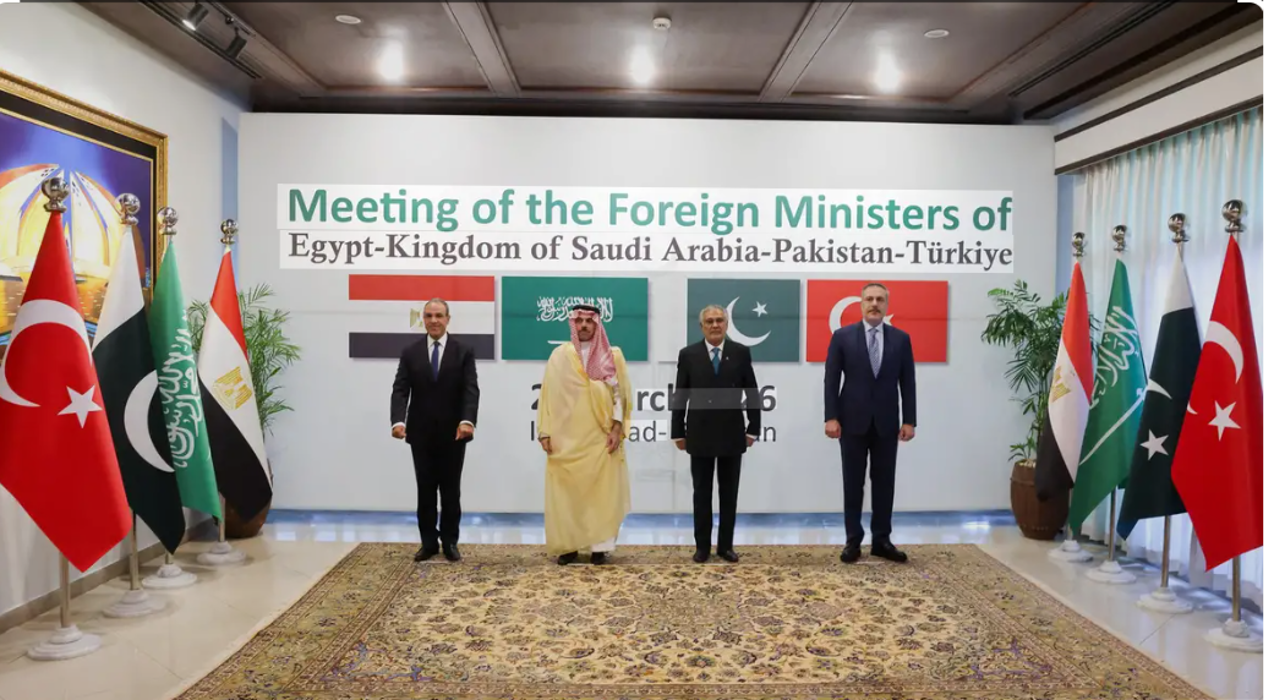
A new regional security alignment is taking shape across the Middle East and South Asia, as Saudi Arabia, Turkey, Pakistan, and Egypt draw closer together in what analysts describe as a strategic hedge against a retreating American presence — and a rising Israeli assertiveness in the region.
Writing for his Substack page, geopolitical analyst Ricardo Martins (May 10, 2026) argues that this emerging quadrilateral framework is not driven by religious solidarity but by cold strategic calculation. Drawing on political scientist Barry Buzan's theory of Regional Security Complexes, Martins contends that the four nations — the most militarily powerful Muslim-majority states in their respective subregions — have developed interlocking threat perceptions that are now translating into concrete defense cooperation.
Each member brings distinct motivations to the table. Turkey, according to Martins citing Chatham House, is engaged in "opportunistic hedging," seeking leverage within NATO while simultaneously building partnerships that reduce its dependency on U.S. approval — particularly after its exclusion from the F-35 program in 2019 following its purchase of Russia's S-400 air defense system. A prospective deal to supply Saudi Arabia with its domestically developed KAAN fifth-generation fighter jet, Martins notes, would bypass U.S. congressional oversight and fundamentally disrupt Washington's grip on regional arms markets.
Saudi Arabia, for its part, is pursuing what Martins calls "strategic insurance." While Riyadh continues to value its American security partnership, it has been quietly deepening military ties with Pakistan to offset what it perceives as declining U.S. deterrence in the Gulf and growing Israeli military assertiveness. Notably, Islamabad has also been brought in as a counterbalance to Turkey's expanding regional clout — a layered hedge within the hedge itself.
Egypt's participation, Martins explains, stems from economic reliance on Gulf states and Cairo's acute concern over Red Sea security. President El-Sisi also sees an opportunity to reclaim Egypt's traditional Arab leadership role. Meanwhile, Pakistani officials see the arrangement as a path to expanded diplomatic influence, financial support, and enhanced strategic stature — a role reinforced by Islamabad's recent hosting of U.S.-Iran nuclear talks.
One of the most sensitive dimensions of the pact is Pakistan's nuclear capability. A senior Saudi official told Reuters that the bilateral Saudi-Pakistan Strategic Mutual Defence Agreement covers "all military means," though nuclear sharing was not explicitly confirmed. Pakistani Defense Minister Khawaja Asif initially suggested nuclear provisions before retracting the statement. Martins cites former Israeli peace negotiator Daniel Levy's observation that the psychological effect of Pakistan's deterrent on Tehran may matter more than its formal scope — deterrence, Levy notes, operates as much on perception as on physical capability.
Martins is careful to distinguish this framework from a so-called "Islamic NATO." Turkish sources told Middle East Eye that the pact would function as "a security platform to enable greater cooperation in the defense industry," not a mutual defense treaty replicating NATO's Article 5 commitments.
The Trump administration has so far responded pragmatically, publicly framing the arrangement as useful burden-sharing — though U.S. officials have privately raised concerns over the KAAN transfer and the erosion of Washington's traditional levers of influence over all four states.
Photo: Source