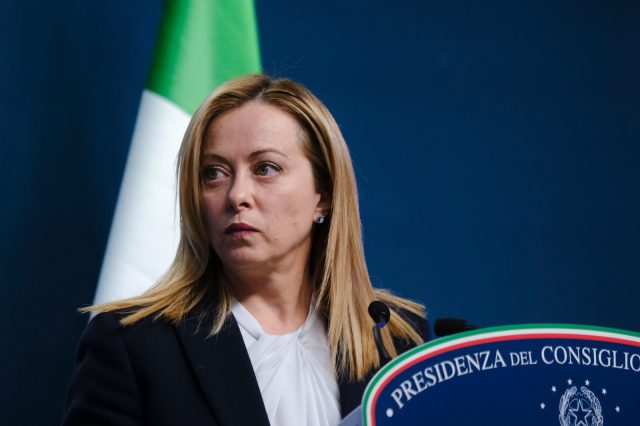
Italy’s recent clash involving Prime Minister Giorgia Meloni, U.S. President Donald Trump and Pope Leo XIV is accelerating a shift toward a conservative vision of a “Europe of Nations,” in which sovereign states reclaim strategic autonomy while remaining inside the Western alliance framework, writes Alessandro Imperiali in The Conservative.
At the heart of Rome’s current posture is the idea of a “Europe of Nations,” rooted in the European right’s tradition and inspired by Charles de Gaulle’s conviction that Europe must be an alliance of sovereign states, not a supranational bureaucracy. In this vision, Italy seeks renewed centrality—especially in the Mediterranean—by asserting more room for national decision‑making without formally breaking from its commitments to NATO, the European Union and the transatlantic relationship.
The immediate trigger for the latest tensions was Italy’s decision not to renew its defense memorandum with Israel, officially justified by repeated attacks on Italian soldiers serving in the UNIFIL mission in Lebanon. While Rome insists this is not an ideological break with Israel, the move is interpreted as a sign that Italy will no longer accept “automatic alignment” and instead reserves the right to recalibrate its security policy based on national interests and the protection of its forces.
Clash over Trump and the Pope
The political dispute escalated when Trump posted a controversial image on Truth Social depicting himself as Jesus Christ, prompting Meloni to openly criticize both the tone and content of the former U.S. president’s communication. Her response, framed as a defense of the cultural and spiritual role of the papacy, drew a line against instrumentalizing religion as mere political spectacle—a stance consistent with a European conservative tradition that treats faith as a source of social cohesion rather than partisan provocation.
Trump’s counterattack came in an interview with Italy’s Corriere della Sera, where he questioned Italy’s reliability and positioning, signaling Washington’s suspicion toward any move by European allies that looks like strategic autonomy. By choosing an Italian outlet, Trump brought the dispute directly into Italy’s domestic debate, increasing pressure on Meloni at home while sharpening the international dimension of the confrontation.
Pope Leo XIV, for his part, has remained outside the political crossfire, limiting his interventions to broad calls for peace consistent with the Holy See’s diplomatic tradition. In this configuration, the papacy appears as a moral reference point attempting to cool tensions, while political leaders in Rome and Washington contest the terms of Western leadership.
Within the alliance, Italian officials insist that the current friction does not amount to a rupture with the United States but reflects a “maturation” of the relationship: allies, they argue, can disagree without breaking ranks. This fits Meloni’s broader ambition to position Italy as a bridge connecting Europe, the Mediterranean and the Middle East—an actor that “counts more without changing sides.”
Europe’s Marginality and the Search for Relevance
The Italian maneuver comes against a backdrop of European marginalization in major global dossiers, symbolized by recent U.S.–Iran contacts held in Islamabad without any European capital at the table. For Meloni, such developments highlight the failure of a technocratic European Union to project power, and strengthen the case for a political “Europe of Nations” that can speak with strategic clarity through its governments rather than its institutions alone.
In that sense, the Trump–Meloni–Pope triangle is less a passing quarrel than a symptom of a deeper rebalancing within the West, in which Italy is testing how far a mid‑sized power can go in asserting autonomy while remaining firmly anchored in its historic alliances. The success or failure of this experiment will help determine whether the “Europe of Nations” can move from slogan to operative framework in the next phase of European politics.
Photo: Source