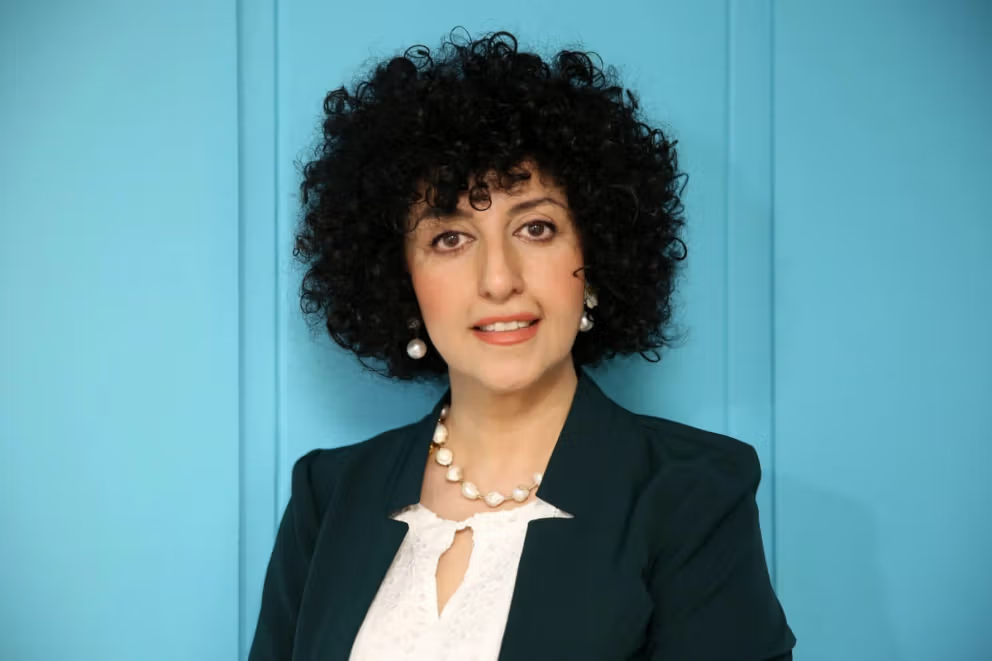
Updated: More Than 110 Nobel Laureates Demand Release of Ailing Iranian Activist Narges Mohammadi

More than 110 Nobel laureates have called for the immediate and unconditional release of imprisoned Iranian human rights activist and 2023 Nobel Peace Prize winner Narges Mohammadi, as concern grows over her worsening health after her transfer to a Tehran hospital.

Mohammadi was moved from Zanjan to Pars Hospital in Tehran after authorities suspended enforcement of her sentence to allow treatment outside prison, according to earlier reports citing her lawyer and the Narges Foundation. Her family and supporters say the transfer is only a temporary measure and warn that she could be sent back to prison once her condition stabilizes.

According to the Guardian, in a statement issued on Tuesday, 112 Nobel laureates urged Iranian authorities and the international community to act quickly to secure her freedom and guarantee continued access to specialized medical care. The appeal came after reports that Mohammadi had suffered severe weight loss, unstable blood pressure and serious cardiac symptoms in detention, including an episode in which she was found unconscious in her cell.

The signatories said medical experts had warned that her life may be in immediate danger and argued that she had been denied the specialized care she needed for months. They also called for all charges against her to be dropped. Among those backing the appeal were laureates from chemistry, economics, literature, medicine, peace and physics, including writers Annie Ernaux and J.M. Coetzee.

Jody Williams, the 1997 Nobel Peace Prize laureate, said Mohammadi should never have been pushed to the brink of death and stressed that no one should be jailed for peaceful activism or defending human rights. Yemeni Nobel laureate Tawakkol Karman described Mohammadi as a fearless voice for Iranian women and said the struggle for dignity and justice could not be silenced by prison.

Mohammadi’s son, Ali Rahmani, said the temporary suspension of her sentence was not enough after years of imprisonment, solitary confinement and what he described as systematic medical neglect. He said the family was demanding her unconditional release and long-term specialized treatment without the threat of being returned to prison.

Mohammadi has been repeatedly detained over her activism, including campaigns against the death penalty and mandatory hijab laws. Earlier reporting on her hospitalization said she had spent 10 days in a hospital in Zanjan before being transferred by ambulance to Pars Hospital in Tehran for treatment under her own doctors’ supervision. Supporters say her case has become a symbol of the broader pressure faced by women’s rights and human rights defenders in Iran.

Photo: Source

More News

Iran’s Leaderless War Machine: The IRGC’s Autonomous Cells and the Escalation Nobody Controls

In the fog of a war that has already claimed Iran’s supreme leader and its top military brass, a new and perhaps more dangerous threat is emerging from the rubble of Tehran’s shattered command structure: a Revolutionary Guard Corps that, by design, no longer needs orders from above. Sources with direct knowledge of the situation confirm that Iran’s Islamic Revolutionary Guard Corps (IRGC) continues to prosecute strikes across the region not under the direction of the new Supreme Leader Mojtaba Khamenei, but according to pre-programmed autonomous protocols embedded deep within its decentralized “mosaic defense” architecture. The result is a war machine that has become, in the most literal sense, self-propelling — and increasingly difficult for anyone to stop. A New Supreme Leader With Limited Command Mojtaba Khamenei was formally elected Supreme Leader on 8 March 2026, succeeding his father Ayatollah Ali Khamenei, who was killed in the opening wave of the US-Israeli “Operation Epic Fury...

2026 US/Israel–Iran War Risk: Why the Chance of Escalation Is Meaningfully Elevated

As 2025 closes, the US/Israel–Iran confrontation is no longer a low-grade shadow struggle managed mainly through diplomacy and proxy conflicts ; it is an openly articulated deterrence contest in which leaders have publicly tied credibility to “red lines” and rapid retaliation. President Trump has stated that if Iran rebuilds its nuclear capabilities or continues rebuilding missile capacity , the response could be immediate and more severe—language that reduces room for quiet de-escalation once a new incident occurs.  At the same time, Iran has replied with warnings of harsh consequences for any renewed attacks, reinforcing a mutual-threat environment where misperception and political signaling can substitute for verifiable facts.  Against that backdrop, the key analytical point for 2026 is not whether a “full war” is the default outcome; it is that the probability that a limited clash escalates into a broader, sustained conflict is meaningfully elevated because the stabili...

Iran's Headscarf Rules Quietly Loosen — But No Law Has Changed

Bareheaded women appear openly in Tehran cafés and streets, yet activists warn the shift is fragile and the law remains on the books. Images have been circulating on social media of something that would have been almost unimaginable in Iran just a few years ago: women sipping coffee in Tehran cafés, strolling busy city streets, and sitting in restaurants — all without a headscarf. The scenes have ignited global attention and renewed debate over whether the Islamic Republic is quietly retreating from one of its most defining ideological pillars. For decades, wearing the hijab in public has been mandatory for all women in Iran — a rule enshrined in the Islamic Penal Code since 1983 and treated as a cornerstone of the clerical state established after the 1979 revolution. Violations could result in fines, arrest, or worse. Yet in recent weeks and months, enforcement appears to have noticeably slackened, at least in major urban centres. A Visible Shift on the Streets Reporters and residents...