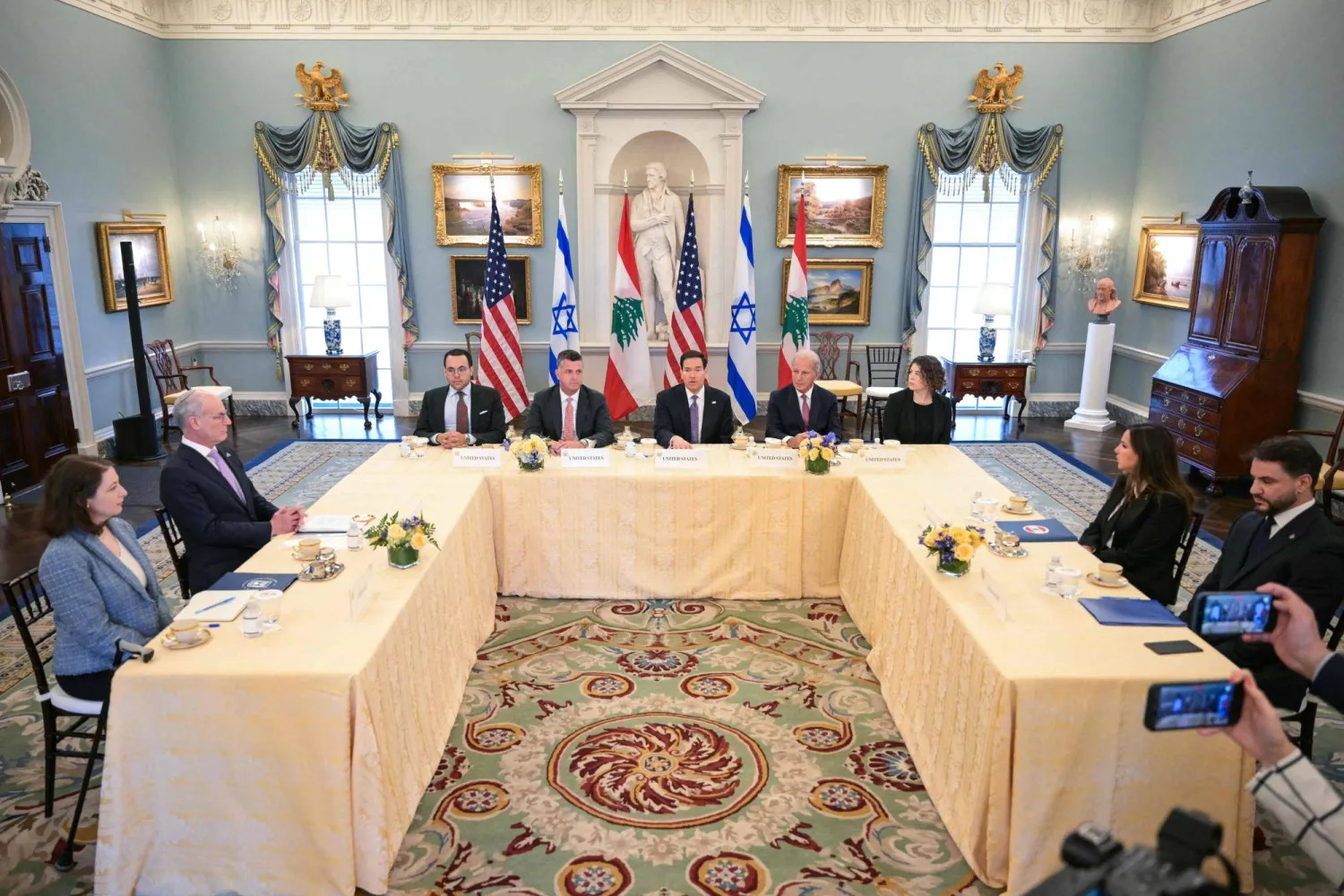
Hezbollah moved swiftly to reject a US-mediated framework agreement signed by Israel and Lebanon in Washington on Friday, with the Iran-backed group’s supporters burning cars and blocking roads in Beirut even as its leaders vowed to keep their arsenal.
The trilateral accord, signed at the State Department by the Israeli and Lebanese ambassadors and announced by Secretary of State Marco Rubio, was not signed by Hezbollah — though the group remains the principal party to the fighting it is meant to end. The framework ties a phased Israeli withdrawal from southern Lebanon to Hezbollah’s disarmament, a condition the movement flatly refuses.
“Our hands are on our weapons,” a Hezbollah spokesperson told Newsweek, warning that further clashes were inevitable if Israel did not pull back fully. “As long as there is occupation, there is resistance.” The spokesperson said the group would honor the deal only if Israel committed in full, rejecting what it called the idea of “surrendering our land to the occupier.”
Hezbollah’s leader, Naim Qassem, set the tone hours before the signing in a televised address marking Ashura. “Israel has no option but to withdraw completely from every inch of our Lebanese land,” he told tens of thousands of supporters. “Israel must leave unconditionally.” He insisted the group would accept “no normalization, no cancellation of the state of hostility, no gains for Israel, and no partial presence on Lebanese soil,” adding that Israel “must leave humiliated and defeated.” Qassem called the resistance “the pillar of Lebanon’s independence.”
Hassan Fadlallah, a Hezbollah lawmaker, was blunter still, warning that Lebanese authorities could only enforce the deal through “civil war.” He branded it “unilateral, gratuitous concessions that will only undermine the country and serve the interests of the Israeli enemy,” and dismissed Prime Minister Benjamin Netanyahu as having “negotiated with himself.” Citing the group’s grip on the south, Fadlallah said the decisive factor was “the field, and we control it.”
The defiance spilled onto the streets. Hezbollah supporters massed in the southern suburb of Dahiyeh overnight, waving the group’s yellow flags alongside Iranian banners, torching vehicles and motorcycles, and cutting the main road to Beirut’s airport. Lebanese army units deployed in force and fired tear gas to disperse crowds who denounced the accord as a “surrender deal.”
Israel cast the agreement as a victory. Netanyahu called it “a major achievement,” vowing that troops would remain in the southern “security zone” “as long as Hezbollah has not disarmed,” and describing the deal as “a major blow to Iran.” Israeli envoy Yechiel Leiter declared that “Iran is out, Hezbollah is out, and the road to peace between Israel and Lebanon is in.”
Analysts cautioned that Hezbollah’s exclusion may doom the framework. “The Lebanese army by itself cannot disarm Hezbollah,” said Rami Khouri of the American University of Beirut. With the group insisting its weapons are non-negotiable and its fighters entrenched south of the Litani, the path from framework to peace remains perilous.
Photo: Asharq Al-Awsat