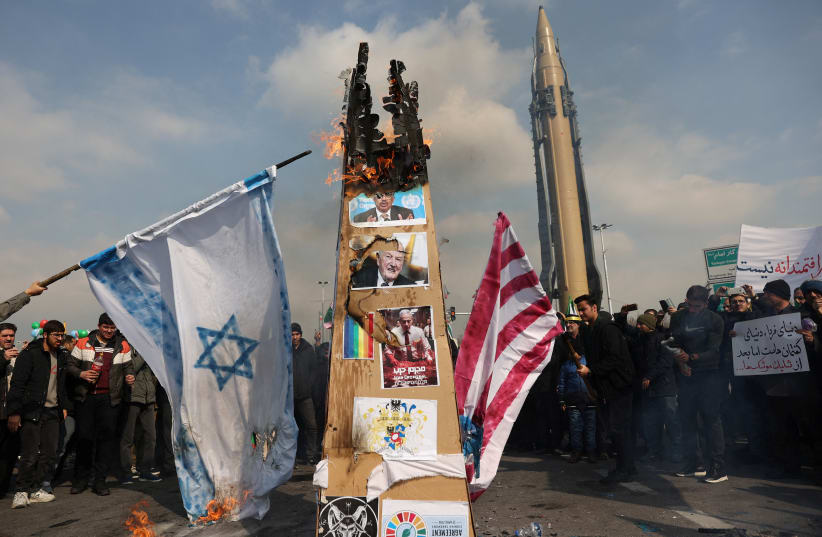
Trump's Nuclear Talks with Iran: A Path to Armageddon, Asks Israeli Press

In a scathing opinion piece published today, the Israeli press warned that President Donald Trump's recent nuclear talks with Iran could lead the world to catastrophe, dubbing them a "giant stride towards Armageddon." The warning of the Jerusalem Post came after Trump's surprise announcement of negotiations in Oman last Saturday, a move that reportedly shocked even close allies like Israel. The newspaper believes the talks are a misguided attempt at diplomacy that will ultimately backfire.

The article argues that any agreement forged with Iran would be "worthless" and simply a façade for Tehran to further its nuclear ambitions. It accuses Iran of long-standing deception, citing its history of hiding nuclear activities from the International Atomic Energy Agency (IAEA) and its alleged use of the Shia Islamic concept of Taqiyya to mislead the West. It also emphasizes that even after signing the Obama-era nuclear deal, Iran continued to lie about its nuclear program, as evidenced by secret files uncovered in a Mossad operation.

According to the Jerusalem Post, the United States, positioned thousands of miles away, cannot fully grasp the threat posed by Iran's nuclear ambitions. The article insists that Israel, which it describes as being "on Iran's doorstep," has firsthand insight into the regime's strategies and intentions. The Israeli newspaper warns Trump against being deceived by Iran's claims of "constructive" diplomacy, likening any compromise to Neville Chamberlain's infamous appeasement of Adolf Hitler.

The Israeli newspaper's ultimate message is clear: no deal will be strong enough to prevent Iran from acquiring nuclear weapons. It advocates for an ultimatum instead—either Iran dismantles its nuclear program entirely, or the U.S. and its allies must take action to destroy it. For the Israeli newspaper, anything less than this will lead the world down a path of destruction.

Photo: The Jerusalem Post

More News

Iran’s Leaderless War Machine: The IRGC’s Autonomous Cells and the Escalation Nobody Controls

In the fog of a war that has already claimed Iran’s supreme leader and its top military brass, a new and perhaps more dangerous threat is emerging from the rubble of Tehran’s shattered command structure: a Revolutionary Guard Corps that, by design, no longer needs orders from above. Sources with direct knowledge of the situation confirm that Iran’s Islamic Revolutionary Guard Corps (IRGC) continues to prosecute strikes across the region not under the direction of the new Supreme Leader Mojtaba Khamenei, but according to pre-programmed autonomous protocols embedded deep within its decentralized “mosaic defense” architecture. The result is a war machine that has become, in the most literal sense, self-propelling — and increasingly difficult for anyone to stop. A New Supreme Leader With Limited Command Mojtaba Khamenei was formally elected Supreme Leader on 8 March 2026, succeeding his father Ayatollah Ali Khamenei, who was killed in the opening wave of the US-Israeli “Operation Epic Fury...

2026 US/Israel–Iran War Risk: Why the Chance of Escalation Is Meaningfully Elevated

As 2025 closes, the US/Israel–Iran confrontation is no longer a low-grade shadow struggle managed mainly through diplomacy and proxy conflicts ; it is an openly articulated deterrence contest in which leaders have publicly tied credibility to “red lines” and rapid retaliation. President Trump has stated that if Iran rebuilds its nuclear capabilities or continues rebuilding missile capacity , the response could be immediate and more severe—language that reduces room for quiet de-escalation once a new incident occurs.  At the same time, Iran has replied with warnings of harsh consequences for any renewed attacks, reinforcing a mutual-threat environment where misperception and political signaling can substitute for verifiable facts.  Against that backdrop, the key analytical point for 2026 is not whether a “full war” is the default outcome; it is that the probability that a limited clash escalates into a broader, sustained conflict is meaningfully elevated because the stabili...

Iran's Headscarf Rules Quietly Loosen — But No Law Has Changed

Bareheaded women appear openly in Tehran cafés and streets, yet activists warn the shift is fragile and the law remains on the books. Images have been circulating on social media of something that would have been almost unimaginable in Iran just a few years ago: women sipping coffee in Tehran cafés, strolling busy city streets, and sitting in restaurants — all without a headscarf. The scenes have ignited global attention and renewed debate over whether the Islamic Republic is quietly retreating from one of its most defining ideological pillars. For decades, wearing the hijab in public has been mandatory for all women in Iran — a rule enshrined in the Islamic Penal Code since 1983 and treated as a cornerstone of the clerical state established after the 1979 revolution. Violations could result in fines, arrest, or worse. Yet in recent weeks and months, enforcement appears to have noticeably slackened, at least in major urban centres. A Visible Shift on the Streets Reporters and residents...